
Page Header Image

Office of the Dean
Building 42, Suite 212
4200 Connecticut Ave. NW
Washington, DC 20008
phone 202.274.5220 | 202.274.5520 | seas@udc.edu

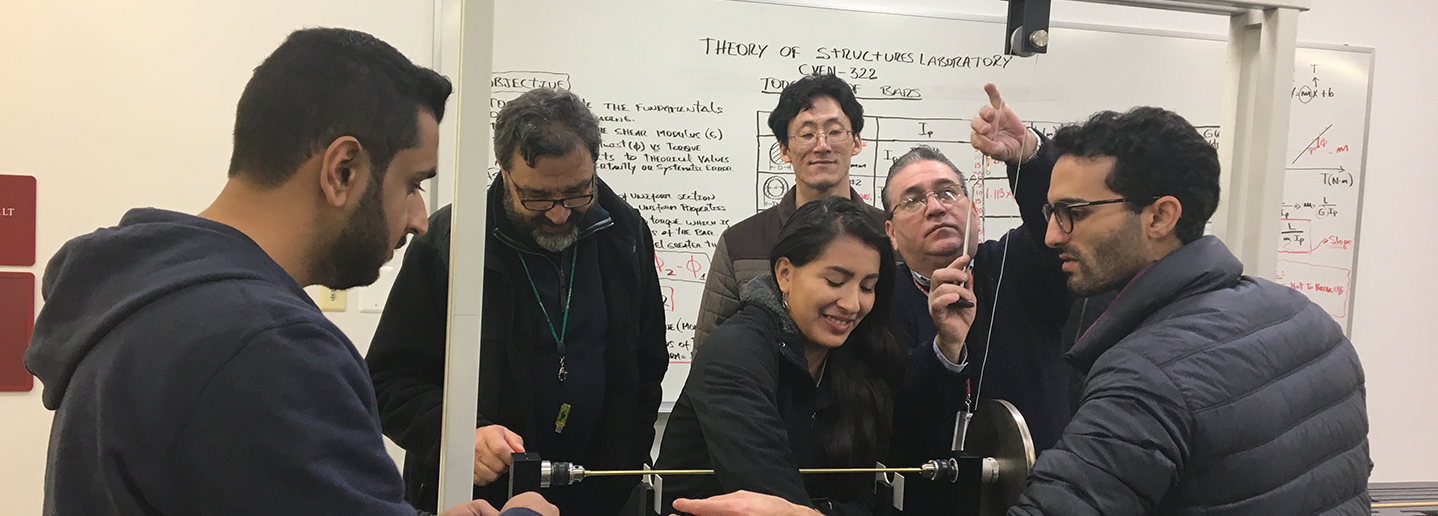
Pictured left: Paul Cotae, Associate Professor, Department of Electrical and Computer Engineering

Bachelor of Science in Civil Engineering

Civil engineering is the oldest branch of the profession of engineering that deals with planning, design, construction and maintenance of the built environment on which society depends. Many of the life sustaining important things in our lives are the product of civil engineering. There are two broad types of civil engineer leaders:  those who work in creating visible infrastructures such as  buildings, highways, bridges, airports, ports, waterways, and dams; and those who work behind the scenes such as in building foundations, water treatment plants, water supply pipe systems, ecological restoration and underground drainage systems.

The program for the Bachelor of Science in Civil Engineering offers four major areas of concentration: water resources engineering; construction; geotechnical; transportation and structural engineering. The Civil Engineering Program is accredited by the Engineering Accrediting Commission (EAC) of ABET.

The objective of the Civil Engineering Program is to prepare students for engineering careers and/or advanced study in civil engineering and to offer research and service programs for the general public. Civil engineers have responsibility for designing various structures, including bridges, highways, and infrastructure facilities. The program places special emphasis on solving problems in urban areas, particularly in the Washington, D.C. metropolitan area. Civil engineers are employed in both industry and governmental agencies. The demand is significantly higher than the number of graduates.

The expertise of the civil engineering faculty, combined with their dedication to quality of instruction, their willingness to provide individual attention to students, and their experience provide the basis for a solid fundamental engineering education.

Program Educational Objectives

In accordance with ABET accreditation criteria and pursuant to the University’s mission statement, the following program educational objectives have been established:

  • Prepare graduates with problem solving skills and knowledge necessary for immediate employment in related fields of civil engineering,
  • Prepare graduates with a capacity to pursue graduate studies in civil engineering or related fields,
  • Prepare graduates with requisite skills to successfully undertake the Fundamentals of Engineering (FE) examination and subsequent licensure as a professional engineer (PE), and
  • Prepare graduates with an ability and capacity to pursue lifelong learning with a creative desire and potential for career growth and development. Prepare graduates as well-rounded engineers who become valuable member of the society at-large with good understanding of social, ethical, technical, environmental and global-context issues and have effective communication skills.

Program Outcomes

Students graduating from the civil engineering program are expected to acquire the following:

  • an ability to apply knowledge of mathematics, science, and engineering
  • an ability to design and conduct experiments, as well as to analyze and interpret data
  • an ability to design a system, component, or process to meet desired needs within realistic constraints such as economic, environmental, social, political, ethical, health and safety, manufacturability and sustainability
  • an ability to function on multi-disciplinary teams
  • an ability to identify, formulate and solve engineering problems
  • an understanding of professional and ethical responsibility
  • an ability to communicate effectively
  • the broad education necessary to understand the impact of engineering solutions in a global, economic environmental and societal context
  • a recognition of the need for, and an ability to engage in life-long learning
  • a knowledge of contemporary issues
  • an ability to use the techniques, skills, and modern engineering tools necessary for engineering practice.

 In addition to these ABET-inspired outcomes, the following outcomes have been developed based on the stipulated program criteria applicable to civil engineering program:

CE (a) An ability to apply fundamentals of probability and statistics in the analysis and design of civil engineering systems, and

CE (b) Faculty members responsible for the upper-level professional program are maintaining currency in their specialty area.

Curriculum (Starting Fall 2010)