


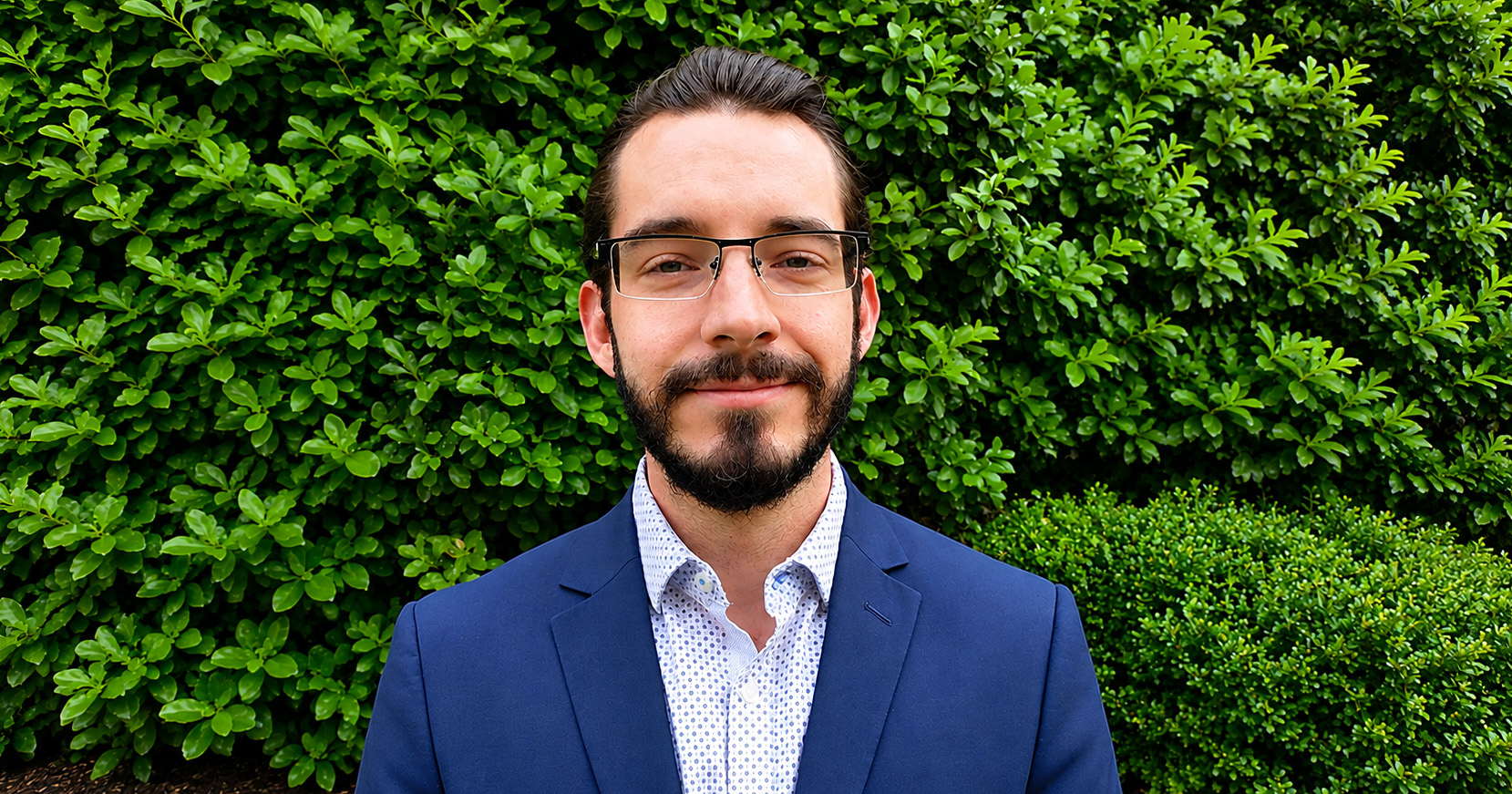
Held each year in November, the national First-Generation College Celebration recognizes students who are the first in their families to attend college. For Christian Aguiar, an associate professor of English at the University of the District of Columbia Community College (UDC-CC) and a first-generation graduate himself, it also raises a larger question: What would colleges do differently if they began with the strengths first-generation students bring rather than what many assume they lack?
That question drives Aguiar’s research on belonging and academic confidence among first-generation and low-income students, such as his 2025 dissertation and findings on how students find and create their own support networks.
“Successful first-generation students often build their own study groups,” Aguiar said. “They do this without prompting from faculty, and they do it to help each other get through. These groups help them find resources on campus, get advice about what classes to take and, of course, study.”
Belonging Can Start Small
Aguiar’s research reflected what he sees every day in the classroom: Students are more likely to participate, ask for help and persist when they believe they belong.
“A student who feels like they belong feels that they have a purpose that fits with that particular place,” he said. “They’re more comfortable asking questions, working with people, listening to feedback and taking an active role in learning. They’re also more likely to keep showing up.”
Belonging does not always require an institution-wide initiative, however. Sometimes it starts with one relationship.
“When I’ve interviewed students who’ve stuck around, they all have their person on campus,” Aguiar said. “For some, it’s a faculty member; for others, it’s an adviser, an administrative assistant or a dean. Everyone has had some person on campus — their person.”
Aguiar builds on that student-led model in his first-year writing courses, where students form groups for each major assignment. They exchange ideas, workshop one another’s writing and become more comfortable taking risks and asking questions.
“Those groups become their people, to some extent,” he said.
The groups foster a different kind of learning — one in which relationships and mutual support become a key part of the academic experience.
Finding His Place in Higher Education
Aguiar’s interest in the subject is personal. He grew up in and around Pawtucket, Rhode Island, considered the birthplace of the American Industrial Revolution, though many of the old mills that had defined the area had closed or were operating on short shifts by the time he was a child there.
He later enrolled at Brown University as a first-generation college student. The university was working to recruit and financially support more students like him, but admission and funding did not automatically create a sense of belonging.
“Working-class people were an invisible minority on campus,” Aguiar said. “I’ll always appreciate the opportunity Brown provided me, but the experience on campus wasn’t a good one.”
He found support among a small group of friends, a few faculty members and others who shared a similar background. When he later attended graduate school, he sought out Georgetown University’s Community Scholars Program because of its longstanding support for first-generation students. Even there, he said, first-generation students could feel expected to adapt to the institution rather than help reshape it. That realization helped draw him to community colleges.
“I wanted to teach somewhere that prioritized the values of working-class communities: hard work, collaboration over competition and trying to give back directly to the communities that helped you,” Aguiar said. “Community colleges, by and large, do just that.”
Changing the Institution, Not the Student
Aguiar believes colleges should examine their own expectations before deciding that students are the ones who need to adapt. First-generation students, for example, are often encouraged to advocate more aggressively for attention from professors. Aguiar asks whether access to faculty should depend on understanding unwritten academic customs or feeling comfortable requesting special help.
One way he changes that dynamic in his own classroom is by setting aside two weeks of regular class meetings each semester for one-on-one conferences with students.
“That shows students that I don’t want them to come see me because they might need help,” he said. “I want to get to know them and their ideas, and I care enough about that to trade some class time for the opportunity.”
The distinction matters: Meeting with a professor becomes part of every student’s education from the outset, not a remedial step for those who are struggling.
A Community From the Start
Aguiar sees that same principle reflected more broadly at UDC, where the community college’s size allows faculty and staff to build relationships with students early in their experience.
“I think UDC does a great job, especially at the community college, of showing students up front that they’re part of a community,” he said. “It’s one building, with dozens — not hundreds — of faculty and staff. We know students by name, we’re able to get to know them and keep track of their progress.”
That sense of community doesn’t always make the coursework easier, but it does give students a community in which to do it. For Aguiar, that is the larger goal: not asking first-generation students to remake themselves to fit college, but allowing what they bring to help shape the college experience.
“It isn’t about changing them,” he said. “It’s about seeing them and building their needs into the work we do.”