


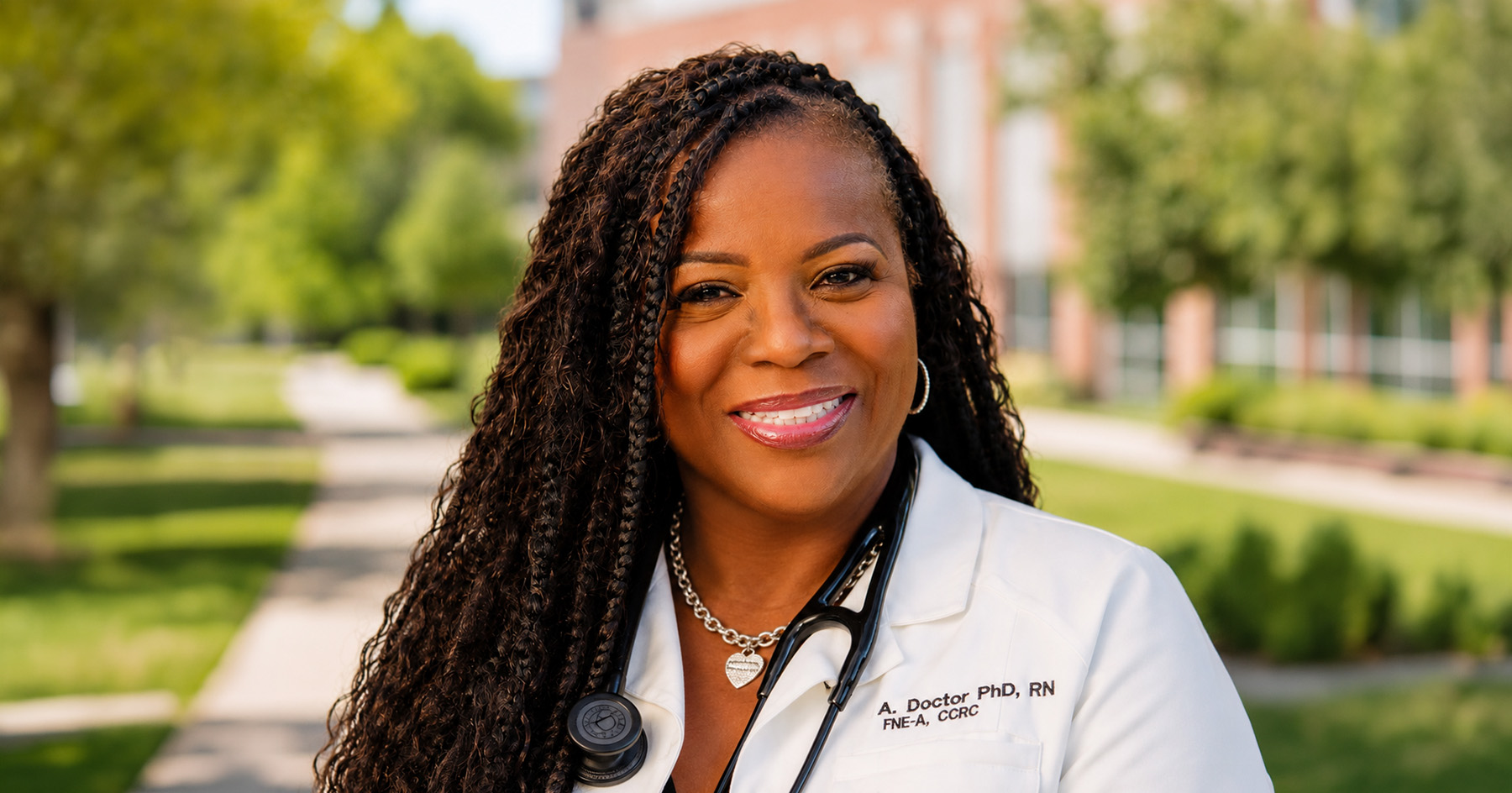
For aspiring registered nurses, passing the national licensing test known as NCLEX is a defining milestone. But for nursing school educators, University of the District of Columbia Professor Andrea Doctor has a bigger question:
“Have we prepared our students not only to pass the NCLEX but for their first real shift as a registered nurse?”
Doctor asked that question at the 2026 NCLEX Virtual Conference on Sept. 10, hosted by the National Council of State Boards of Nursing, which develops and administers the nursing licensing examination.
Her presentation, “Bridging the Gap: A Workforce Readiness Nursing Education Model,” introduces Doctor’s R.E.A.L. Nurse Transition Model, an approach designed to strengthen clinical judgment, confidence and readiness as nursing students move from the classroom into professional practice.
A Practical Education for Preparing New Nurses
Doctor began thinking more deeply about the transition after listening to UDC graduates describe their first experiences on the job.
“They were passing their courses, completing clinical experiences and demonstrating the knowledge needed to become nurses,” she said. “But once they entered the workforce, some of them would come back and say, ‘This is not what I thought nursing was going to be like.’”
As both a professor and practicing nurse herself, Doctor understood the disconnect.
“We can teach students the pathophysiology, medications, assessments and evidence-based interventions,” she said. “But actual nursing practice is rarely presented one problem at a time.”
A new nurse may be caring for a patient who is struggling while another needs pain medication, a family member has questions, a provider is calling, an admission is arriving and documentation remains unfinished.
“At the same time, that nurse has to recognize which situation cannot wait,” Doctor said. “That is where clinical judgment becomes critical.”
Her response is what she calls “practice-real education.”
“I intentionally give students situations where there may be multiple competing priorities, incomplete information, interruptions, changes in patient condition, communication challenges and uncertainty,” she said. “I want them to experience some of that cognitive pressure while they are still students and have faculty there to coach them, debrief with them and allow them to learn from their decisions.”
“The goal is not to make nursing school unnecessarily stressful. The goal is to make the transition into nursing practice less of a shock.”
A New Model for Success
Doctor’s R.E.A.L. model brings together four elements: resilience, experiential artificial intelligence, adaptive clinical judgment and longitudinal support.
Students encounter “reality shock” simulations involving heavy patient loads, conflict and time pressure; AI-supported scenarios that change in response to their decisions; tools for recognizing and analyzing clinical cues; and continued mentorship designed to bridge the transition from school to practice.
In a traditional case study, the facts and outcomes are largely predetermined. In an adaptive simulation, the patient's condition can change depending on what a student recognizes and does.
“If the student asks the right questions, prioritizes appropriately or recognizes deterioration, the scenario can move in one direction,” Doctor said. “If the student misses an important cue or delays an intervention, the patient’s condition can evolve differently. That creates something closer to clinical practice because real patients do not hand nurses a list of multiple-choice answers.”
Getting Comfortable With Uncertainty
Preliminary findings from 20 students participating in Doctor’s study are promising. All reported that the model helped them feel better prepared for real-world situations, more confident in their clinical judgment and better able to adapt to unpredictable situations and manage stress and workload.
But Doctor has also noticed a subtler change.
“At first, students may want reassurance: ‘Am I doing this right?’ or ‘What is the correct answer?’” she said. “As they progress, I see them becoming more comfortable explaining their reasoning: ‘This is what I noticed. This is what concerns me most. This is what I would do first, and this is why.’
“What has surprised me is that some of the greatest growth is not necessarily in knowing more facts. It is in students becoming more comfortable with uncertainty. They begin to understand that being a safe nurse does not mean knowing everything. It means recognizing when something is wrong, knowing what information you need, knowing when to escalate a concern and not being afraid to ask for help.”
For Doctor, the work is also personal. Before becoming a UDC professor, she was a UDC nursing student.
“I was once the student sitting in those same classrooms,” she said. “UDC helped build the foundation that prepared me to become the nurse and educator I am today.”
Now she is helping prepare the nurses coming behind her.
“My legacy is to help ensure that our students do not simply graduate and pass the NCLEX, but that they enter the profession with the clinical judgment, confidence, resilience and readiness to successfully transition from student to professional nurse.”
For Doctor, that means narrowing the distance between what students learn in nursing school and what the profession will actually demand of them. Or as she puts it, “Practice-ready nurses require practice-real education.”