


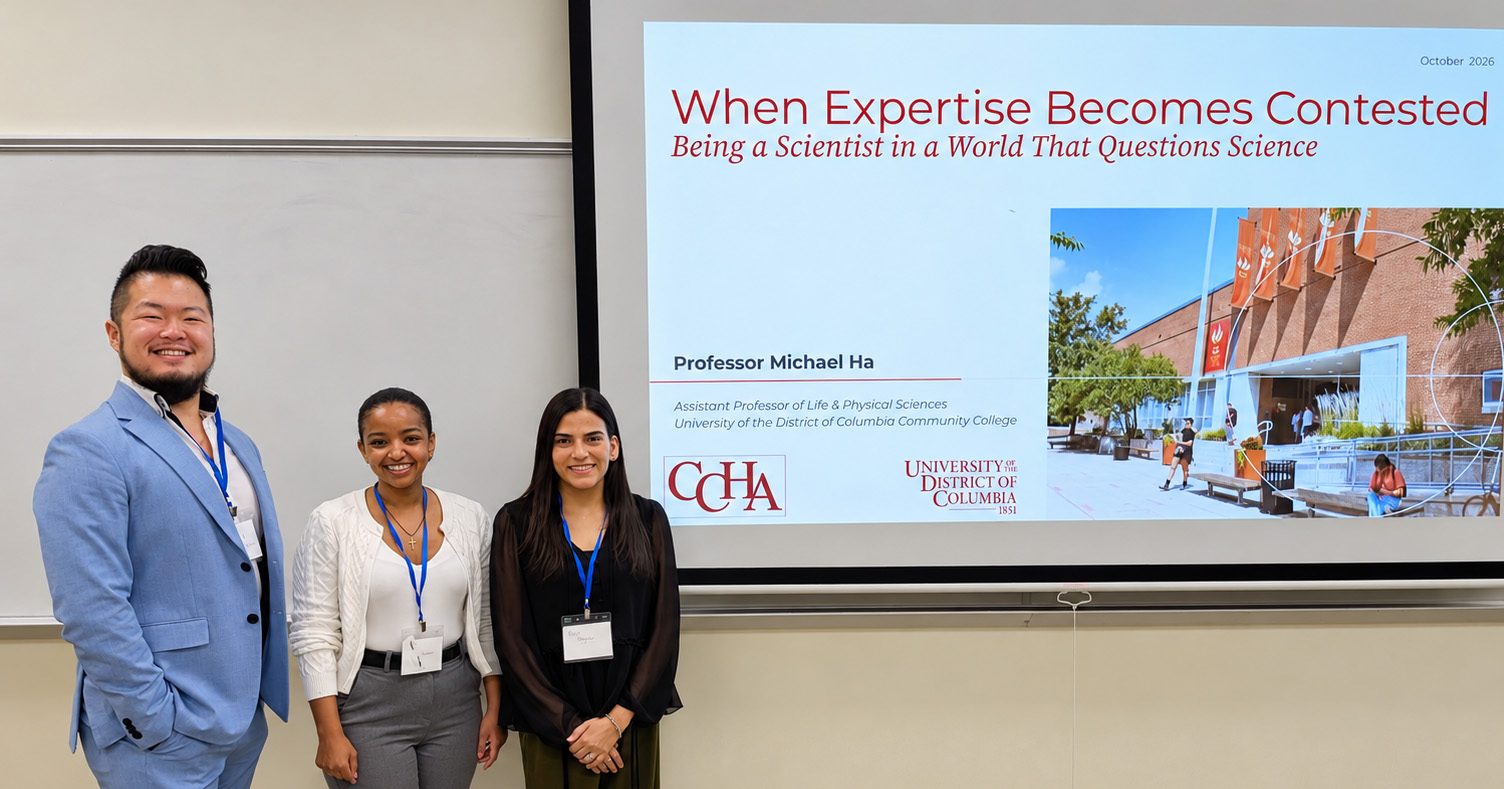
At the 2026 Community College Humanities Association National Conference, University of the District of Columbia Community College (UDC-CC) students Adey Shewafera and Myra Asghar presented their work to a room full of faculty. They were the only students on the program.
It was both students’ first academic conference, and their presentation drew an enthusiastic response, including praise from one faculty member who called it “refreshing and insightful.” They left thinking more seriously about advancing their education and continuing their research.
For UDC-CC Assistant Professor Michael Ha, the experience showed what can happen when community college students receive the opportunity and support to see themselves as researchers.
“A conference is more than an opportunity to present a project,” Ha said. “It gives students the chance to see themselves as contributors to an academic conversation, to receive feedback from experienced scholars and to discover opportunities they may not previously have considered.”
Ha came to UDC-CC with his own substantial research background in clinical medicine, surgery and health sciences. Now, as chair of its Interdisciplinary Research Club, he is working to make research a visible and routine part of the student experience — not something associated only with advanced degrees or large research universities.
Making Research Visible
The effort gained momentum with the 2024 launch of the Interdisciplinary Research Club and UDC’s 2025 Research Week. Since then, the number of faculty involved has tripled, and UDC-CC has increased the number of projects it presents during the university’s annual research showcase.
Research is also moving beyond the Interdisciplinary Research Club. More faculty members are developing projects with students, while students are drawing ideas and encouragement from their peers’ accomplishments. Ha hopes to create a culture in which both groups see research as a natural extension of the teaching and learning already underway.
“When a student sees a classmate presenting at a national conference, research becomes much less abstract,” Ha said. “It becomes something they can see themselves doing as well.”
Starting With Curiosity
One of the first barriers Ha has tackled is the idea that researchers are a particular kind of student with a particular background. Research, he argues, begins with something much more familiar.
“Research begins with curiosity: asking a question, investigating it systematically and being willing to follow the evidence wherever it leads,” he said.
At UDC, that can mean starting small, encouraging students to explore questions that interest them and recognizing their early successes. A project does not need to begin with an ambitious study or a sophisticated laboratory. It can begin with a question a student genuinely wants to answer.
While Ha does not expect every student to become a professional researcher, he believes every graduate should understand how research is developed and evaluated.
“In a world where information — and misinformation — is abundant, and even the concept of truth is increasingly contested, every student should leave college with some understanding of how we distinguish a well-supported conclusion from an unsupported claim,” he said. “Those skills are essential regardless of a student’s chosen career.”
Baking Research Into the Curriculum
For research to become part of the broader student experience, Ha believes it must be incorporated into everyday coursework rather than left as a specialized pursuit students must seek out on their own.
He envisions a progression in which students first learn to evaluate existing evidence, then develop questions, gather or analyze data and communicate their findings. Not every project needs to lead to a conference or publication. The essential experience is investigating a question for oneself.
“Ultimately, I would like this to be a college-wide model in which research is an accessible part of the curriculum,” Ha said, “while the Interdisciplinary Research Club provides a pathway for students who want to pursue it more deeply.”
That model is central to Ha’s long-term goal: research literacy woven throughout UDC-CC, with every student encountering research fundamentals in at least one course before graduation. Research Week would be familiar to all, supported by a steady pipeline of projects and more opportunities to present or publish.
Students who arrive with a particular interest in research would find a clear path from their first semester: joining the Interdisciplinary Research Club, connecting with a faculty mentor and receiving guidance as they build their skills and pursue opportunities at UDC and beyond.
Most of all, Ha wants the effort to become larger than any individual faculty member or organization.
“The goal is to establish the structures, mentorship and opportunities that allow research to continue growing even as students and faculty change,” he said. “If we can help students leave UDC not only with a degree, but with the confidence to ask meaningful questions, evaluate evidence and contribute to knowledge, then I believe we will have accomplished something lasting.”
Opening New Possibilities
Ha has accompanied four UDC-CC students to national conferences, where community college students are often underrepresented. Beyond presenting completed projects, they gain confidence and a clearer understanding of the academic and professional opportunities that might follow. All four are considering developing their projects into manuscripts for possible publication.
“Sometimes, the most important outcome is that a student who had never considered research as an option begins to see it as a genuine possibility,” he said.
Working with community college students has also changed how Ha thinks about his own role. At research-intensive institutions, he said, publication and productivity can become the central measures of success. At UDC-CC, he has returned to the fundamentals: curiosity, the pursuit of truth and the process of discovering how we know what we know.
“When students begin to appreciate those things, research becomes more than an academic achievement,” he said. “It becomes a way of thinking.”
The experience has reinforced his belief that a student’s choice of institution does not define their intellectual potential.
“People attend community college for many reasons, and their choice of institution should never be mistaken for a measure of their academic ability or intellectual potential,” Ha said. “An inquiring mind can be found in any classroom.”