


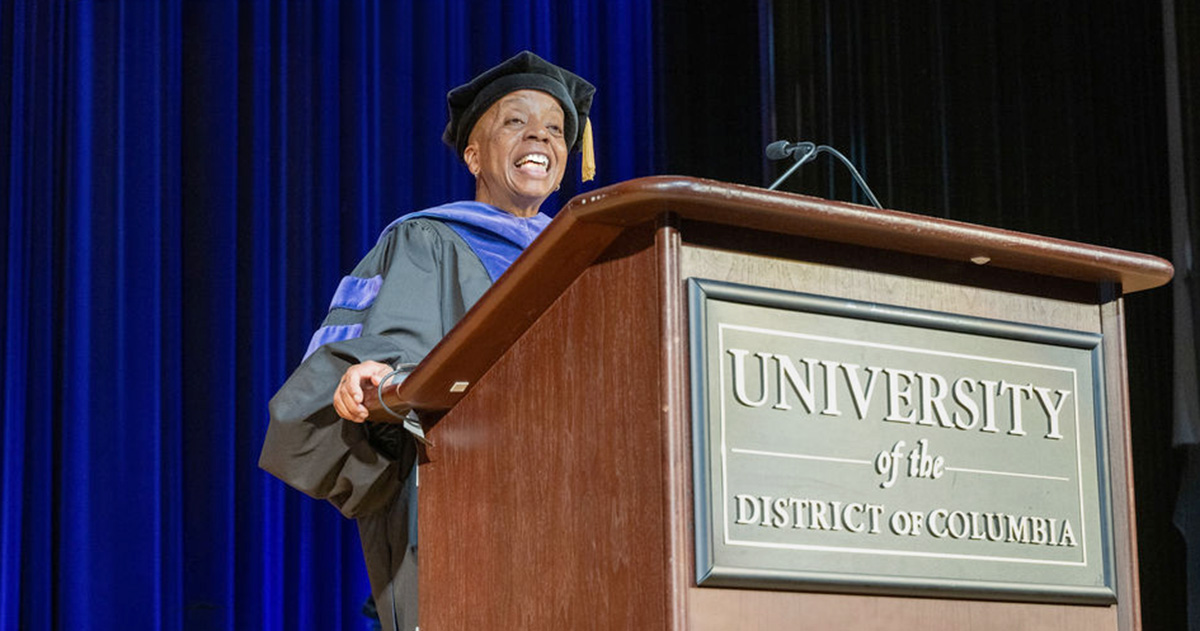
As the University of the District of Columbia marks its 175th anniversary, the UDC David A. Clarke School of Law continues to reflect the university’s mission as a public institution serving the District of Columbia. In this conversation, Interim Dean Angela Gilmore discusses the evolution of the Law School, the importance of clinical and experiential legal education, and the responsibility of preparing future lawyers to serve communities with skill and integrity.
PLJ: As UDC marks its 175th anniversary, what does this milestone represent for the David A. Clarke School of Law and its mission?
AG: The Law School is proud to be part of a university with a 175-year history rooted in access, equity, and service to the people of the District of Columbia. This history supports and guides the values that animate our work at the Law School every day.
The Law School’s history began in 1972 when the Antioch School of Law was founded. The organizing principle of Antioch School of Law was that legal education should be experiential, community-engaged, and unapologetically committed to justice. That principle is not simply part of our history; it is part of our identity. It was there in 1986 when the Council of the District of Columbia passed legislation establishing the District of Columbia School of Law, a new institution that retained Antioch’s mission, curriculum, clinical programs, and personnel after Antioch School of Law closed. It was still there in 1996 when the Law School became part of the University of the District of Columbia. Our mission has remained consistent; what changed is that we found a public home that fully aligns with and amplifies our purpose.
This anniversary represents the convergence of two legacies. From Antioch, we inherited a commitment to clinical education and public-interest lawyering. From the university of the District of Columbia, we inherited a long tradition of expanding opportunity and serving communities too often left behind. Together, those histories shape our present and guide our future.
As we reflect on 175 years of the university and 30 years as part of it, we recommit ourselves to strengthening experiential learning, investing in student success, deepening community partnerships, and ensuring that our graduates not only enter the profession—but transform it.
PLJ: The Law School has a nationally recognized focus on public interest law. How does that focus shape the student experience and the school’s impact?
AG: Our focus on public interest law grounds us. For our students, that means they do not wait until after graduation to engage in meaningful legal work. Through our clinical program and experiential learning opportunities, they represent real clients, solve real problems, and confront real questions of equity and access to justice while they are still in law school. They learn doctrine in the classroom while developing professional judgment, ethical responsibility, and an understanding of the human dimensions of the law in practice settings.
In terms of impact, our focus ensures the Law School is not insulated from the community. Through our clinics and partnerships, we provide critical legal services to individuals, families, small businesses, and nonprofits in the District of Columbia and beyond. At the same time, our graduates enter the profession prepared to serve as public defenders, prosecutors, nonprofit leaders, government attorneys, policymakers, and advocates for systemic reform. As a result, the Law School’s impact extends far beyond our building and into the communities we are called to serve.
PLJ: What is one program, clinic, or outcome that best illustrates how the Law School advances access to justice in the District and beyond?
AG: UDC Law’s legal clinics advance access to justice by narrowing the gap between legal need and legal representation. In the District of Columbia, too many residents face eviction, domestic violence, immigration challenges, barriers to small business formation, criminal prosecution, and other legal issues without meaningful access to representation. Our clinics intervene directly in that reality. Under faculty supervision, our students provide high-quality legal services to real clients by drafting pleadings, negotiating settlements, appearing in court, advising nonprofits, and supporting community-based organizations.
That work serves two purposes. First, it delivers immediate legal assistance. Second, it builds long-term capacity in the profession. Our students graduate having already represented clients and confronted the structural dimensions of inequality embedded in the legal system. They do not enter the profession as observers of injustice. They enter as lawyers trained to address it competently and ethically.
Significantly, our impact extends beyond the District. Many of our graduates serve in federal agencies, nonprofit organizations, public defender offices, prosecutors’ offices, and advocacy organizations across the country. The habits of practice they develop in our clinics—client-centered lawyering, cultural humility, ethical reflection and systems awareness—travel with them.
Our legal clinics are not ancillary to our program of legal education; they are central to it. They ensure that access to justice is not a slogan but a lived experience for our students and our community. They represent the most direct way we fulfill our public mission as a law school serving the nation’s capital.
PLJ: How does experiential learning—through clinics, advocacy, and community-based work—prepare students for meaningful legal careers?
AG: Through experiential learning, our students move beyond analyzing appellate opinions and begin assuming the responsibilities of lawyers. They interview and counsel clients, draft motions and agreements, negotiate with opposing counsel, appear before tribunals, and make strategic decisions under faculty supervision. In doing so, they develop not only technical competence but also professional judgment.
This kind of learning accelerates readiness. Students learn how to manage cases, communicate clearly under pressure, exercise ethical discretion, and navigate the realities of courts and administrative agencies. They confront ambiguity, experience accountability, and learn that lawyering requires preparation, empathy, discipline, and reflection.
Equally important, experiential learning deepens purpose. When students represent a tenant facing eviction or assist a small nonprofit organization serving vulnerable populations, the law is no longer abstract. They see its power and its limits. They begin to shape their professional identities around service, integrity, and impact.
The result is that our graduates do not enter the profession as observers. They enter as lawyers who have already practiced law. Whether they pursue public service, private practice, government, or policy work, they carry with them habits of competence and conscience. Experiential learning ensures that our students graduate not only bar-ready, but practice-ready and prepared for meaningful careers grounded in both skill and purpose.
PLJ: In what ways does the Law School’s work intersect with broader issues of equity, civic engagement, and public service?
AG: Our work intersects with equity, civic engagement and public service in both structure and substance. It is not peripheral to what we do; it is embedded in how we educate lawyers and how we serve the community.
First, equity shapes who we educate and how we support them. As a public law school serving the District of Columbia, we are committed to expanding access to the profession. Many of our students are first-generation professionals, working adults, caregivers, and community leaders. Our academic support systems, experiential learning model, and student services infrastructure are designed to ensure that talent, not privilege, determines opportunity.
Second, civic engagement is central to our pedagogy. Through clinics, advocacy projects, and community partnerships, our students engage directly with courts, administrative agencies, nonprofits, and grassroots organizations. They do not study civic systems from a distance; they operate within them. They learn how the law impacts the lives of real people. In doing so, they develop an understanding of the law as a tool of democratic participation and accountability.
Third, public service is both a value and a professional expectation. We prepare students to enter government service, public defense, prosecution, nonprofit advocacy, judicial clerkships, and mission-driven private practice. Even those who enter corporate or traditional practice settings graduate with a deep awareness of professional responsibility and the broader social impact of legal decision-making.
Ultimately, our intersection with equity, civic engagement, and public service reflects our identity as a public institution in the nation’s capital. We are educating lawyers who understand that the practice of law carries civic weight. Our graduates leave not only with doctrinal knowledge and technical skills, but with a clear sense that their work participates in the ongoing project of strengthening institutions, expanding opportunity, and advancing justice.
PLJ: Looking ahead, what excites you most about the future of the David A. Clarke School of Law within UDC?
AG: What excites me most about the future of the University of the District of Columbia David A. Clarke School of Law is the clarity of our identity and the strength of our moment.
We are a public law school within a historic public university in the nation’s capital. That positioning is powerful. It gives us both responsibility and opportunity. I am energized to build on our clinical legacy while expanding into emerging areas of impact, including technology, social justice, and consumer protection. The Law School is uniquely positioned to prepare lawyers who are not only practice-ready, but also systems-aware—lawyers who understand how institutions function and how to improve them.
I am also excited about strengthening pathways for our students: clearer pipelines from admission to bar passage to employment; deeper partnerships with courts, agencies, firms, and nonprofits; and continued investment in academic support and professional identity formation. Our students arrive with purpose. The future lies in ensuring that we match that purpose with structure, mentorship, and opportunity.
The future excites me because it is not abstract. It is strategic. And we are building it intentionally.