


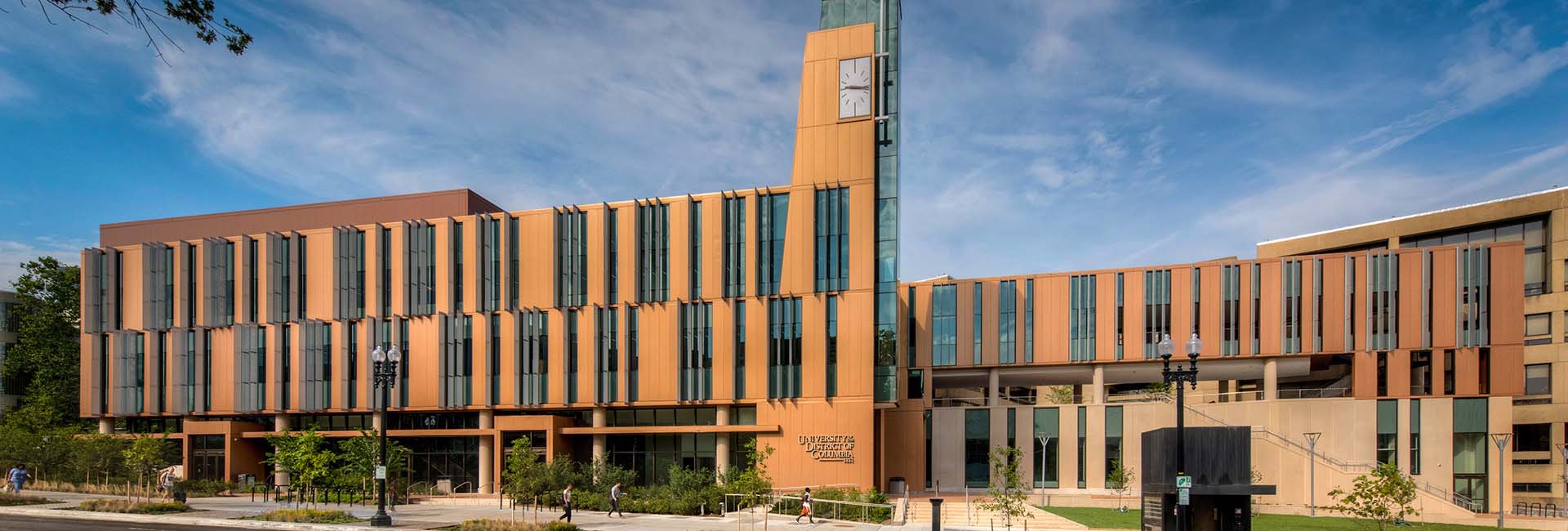
Center of Climate Change Analytics
Mission
The Center of Climate Change Analytics (C3A) is a founding educational and research platform at the University of the District of Columbia to train undergraduate and graduate students to become transformative leaders in workforce, government and beyond to address emerging contemporary issues of climate change; and to advance our basic understanding and developing solutions to address the impacts of climate change on communities, ecosystems and urban infrastructure through the application of game theory.
Vision
The Center of Climate Change Analytics (C3A) aspires to create doctoral research capabilities to help all levels of students achieve their highest level of human potential (UDC’s Vison) by preparing students to become problem solvers of contemporary emerging issues of climate change and extreme events.
Goals
- Educational Enrichment: Integrate Climate Change and related issues into curriculum and deliver quality education to diverse Undergraduate and Graduate students with a goal of building needed technical skill sets in the future work force
- Research Enrichment: Create UDC Faculty research capabilities to advance science and engineering with respect to the nexus of Data, Uncertainty, and Game Theory Modeling in their application to Climate Change problems and decision strategies
- Partnership Development: Develop unique cross-industry connections, stake holders including officials from coastal towns and cities for developing practical, data driven analytical solutions and provide access to UG and GR university students as well as high school students for future workforce development
Research Focus
The research of the Climate Change Analytics Center at UDC focuses on three key pillars: (1) Data, (2) Uncertainty, and (3) Modeling. It is important to note that data, in a general sense, represents the current depth of knowledge of society, which is continuously growing. Therefore, it is imperative that future efforts account for that growth of knowledge and for the potential for new knowledge to fundamentally change our understanding of the forces of climate change. Game theory modeling can answer this challenge through a comprehensive framework that can easily adjust to new data or new knowledge. New knowledge, at its core, mainly affects the level of uncertainty associated with future events. The core goal of the research of the HBCU RISE Climate Change Center at UDC is to utilize game theory to explore the space of the uncertainties of the forces of climate change and chart robust decision strategies.
One key research impact of the Climate Change center will be the enablement of expanded research potential that will build upon the accomplishments of the activities of the center to create enhanced analysis and prediction capabilities. The research avenues enabled by this center have the potential to attract additional funding from a wide variety of agencies and private industries. Furthermore, the talent pipeline created by the center will continue to draw underrepresented individuals towards advanced degrees through various projects in the enabled research domain. The enabled research can be divided into three main categories: (1) Climate Change Impacts Analysis, (2) Community Impacts Analysis, and (3) Enhanced Modeling Capabilities.
Broader Impacts
The impact at UDC of the Climate Change Analytics Center will be the start of an educational and research engine that will develop and support the early careers of multiple faculty members, enable multidisciplinary research coordination with other departments, and create opportunities for students to pursue advanced degrees. The Climate Change Analytics Center will act as a unifying hub to draw faculty from a variety of disciplines, which are all impacted by climate change, in order to focus their efforts towards providing solutions to the many issues emanating from climate change.
The establishment of a research center will aid in the development of connections with industry and agency partners and thus position UDC to utilize the research outcomes in order to provide solutions to specific climate change issues across the region. The climate change analytics center will also serve to attract future students from underrepresented groups and provide them with the necessary means to pursue advanced degrees, overcoming the various barriers that they currently face. Upon graduation, these students will contribute to agencies and industries, thus propelling the world towards an inclusive workforce that will create solutions that are informed by the unique perspectives that underrepresented groups have to offer.
The collaboration between the different departments within the University of the District of Columbia, a HBCU, will produce a synergistic relationship between faculty and various groups of students. With growing faculty expertise, UDC will gain national and international significance and will foster new partnerships and collaborations to benefit our faculty and students, who will be provided with opportunities to explore new ideas and concepts to generate solutions to society.
Director
Dr. Bryan Higgs
[email protected]
202-274-6600