


When Phronie Jackson begins a community health project, she does not start by telling people what they need. She starts by listening.
“Communities do not need to be rescued; they need to be respected, heard, valued and empowered,” Jackson said.
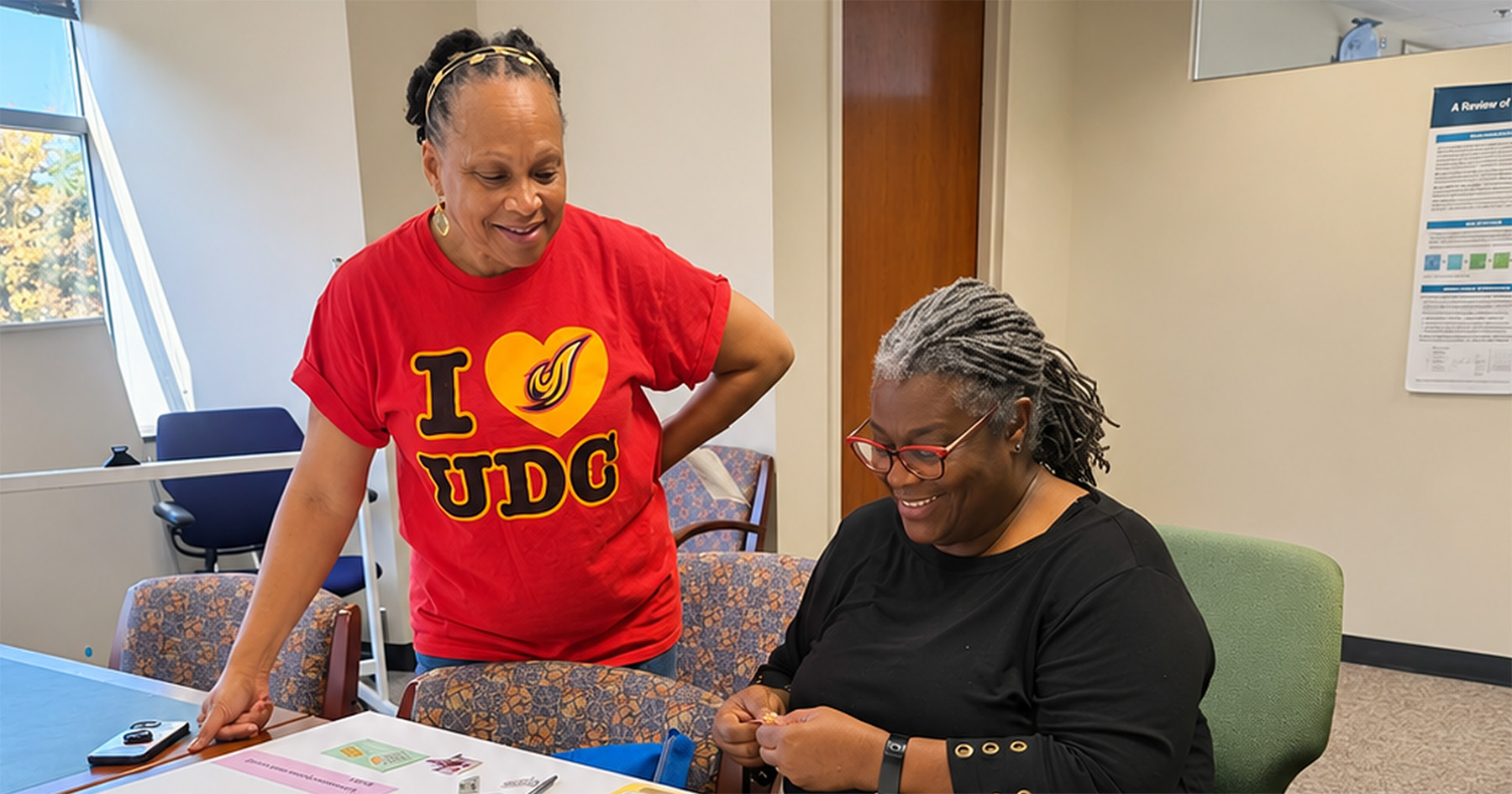
That belief has guided Jackson through decades of work spanning HIV prevention, mental health, chronic illness, nutrition and healthy aging. Today, as an associate professor and program coordinator for Community Health Sciences at UDC, it shapes both her research and the way she prepares students to serve communities in the District and beyond.
Trust Before Intervention
Jackson understands why some communities distrust health care institutions, researchers and other systems that arrive promising help. Too often, she said, organizations have approached communities through the lens of what they lack, collected information and left without sharing their findings or providing lasting resources.
“Effective public health begins with authentic relationships, cultural humility and mutual accountability,” Jackson said. “We must move beyond simply telling people what they need and instead work alongside them to identify sustainable solutions.”
That means looking beyond health care itself. Community health is reflected in whether people have safe places to live, learn, work, worship and play; reliable transportation; nutritious food; supportive relationships; and access to the quality care they need. When those conditions are working well, Jackson said, they can become almost invisible—simply part of what people expect from daily life.
Health is also shaped by far more than individual behavior. Family and peer influences, culture, education, economic opportunity, neighborhood conditions and public policy all affect a person’s ability to protect their health.
One common misunderstanding, Jackson said, is treating equality and equity as interchangeable.
“Equality provides everyone with the same resources,” she said. “Equity recognizes that individuals and communities have different needs and may require different levels of support to achieve comparable health outcomes.”
Making the Research Real
Jackson’s research interests may initially appear wide-ranging, but she sees a clear connection among them.
“They are connected by two fundamental elements: the health needs of my community and my commitment to translating research into meaningful practice,” she said.
Her work centers on dissemination and implementation science — the study of how proven interventions can be successfully adopted, adapted and sustained in real-world settings.
A program that works with one group will not necessarily produce the same results elsewhere. Culture, social conditions, available resources and community priorities can all affect whether an intervention succeeds. Jackson examines those differences and asks what must change for a program to work for the people it is intended to serve.
“For me, research is most meaningful when the communities we study are also the communities that benefit,” she said.
Her Mental Health First Aid project with older District residents offered a concrete example. During six-month follow-up conversations, participants described sharing what they had learned with their family members, friends, pastors and other trusted community leaders. They also called for similar programs to be offered in neighborhood settings, beyond UDC‘s campus.
Their feedback helped create opportunities to bring the program to older adults in Wards 7 and 8 and informed an adapted version designed around the communities’ cultural, social and practical needs.
“The most encouraging outcome was seeing participants become advocates for mental health awareness within their own communities,” Jackson said.
Preparing the Next Generation of Public Health Leaders
Community health workers frequently serve as bridges between health systems and the people those systems are trying to reach. Their effectiveness, Jackson said, comes from community knowledge, cultural understanding, empathy, ethical practice and familiarity with available services.
At UDC, the Community Health Sciences program builds upon those essential skills, preparing students for roles in health education, community engagement, research, program coordination and public health management.
That preparation extends well beyond the classroom. Students complete a year of field-based learning, connecting academic knowledge with hands-on experience in the kinds of organizations and settings where they may eventually work.
“I often tell my students, ‘Washington, DC, is our laboratory, but the world is our classroom,’” Jackson said.
Students learn to assess community needs, develop and implement programs, evaluate results and build partnerships around pressing health concerns. Graduates are prepared for opportunities with local and federal health agencies, nonprofit and community-based organizations and health-related service programs, as well as graduate study in public health and related fields.
“My goal is for students to graduate with more than academic knowledge,” Jackson said. “I want them to leave UDC with the confidence, competencies and commitment to make a meaningful difference wherever their careers take them.”
Envisioning a Healthier DC
Jackson’s vision extends beyond any single course, research project or health intervention. She imagines a student-centered Community Health Hub that would bring together Community Health Sciences students and faculty with health practitioners, community partners and students from fields including counseling, social work, political science, engineering and agriculture.
Working across disciplines, participants could address food access, preventive health, neighborhood conditions and other priorities identified by DC communities themselves.
Jackson also advocates for a “Health in All Policies” approach: recognizing that decisions about housing, transportation, education, economic development and the environment are also decisions about health.
“I believe UDC is uniquely positioned to help lead this transformation,” she said. “As the District’s public university, we have both an opportunity and a responsibility to advance the well-being of the communities we serve.”
For Jackson, that responsibility begins where her work has always begun: with sustained relationships and respect for the people most affected.
“Trust is not something we request,” she said. “It is something we earn through consistency, transparency and genuine care.”