


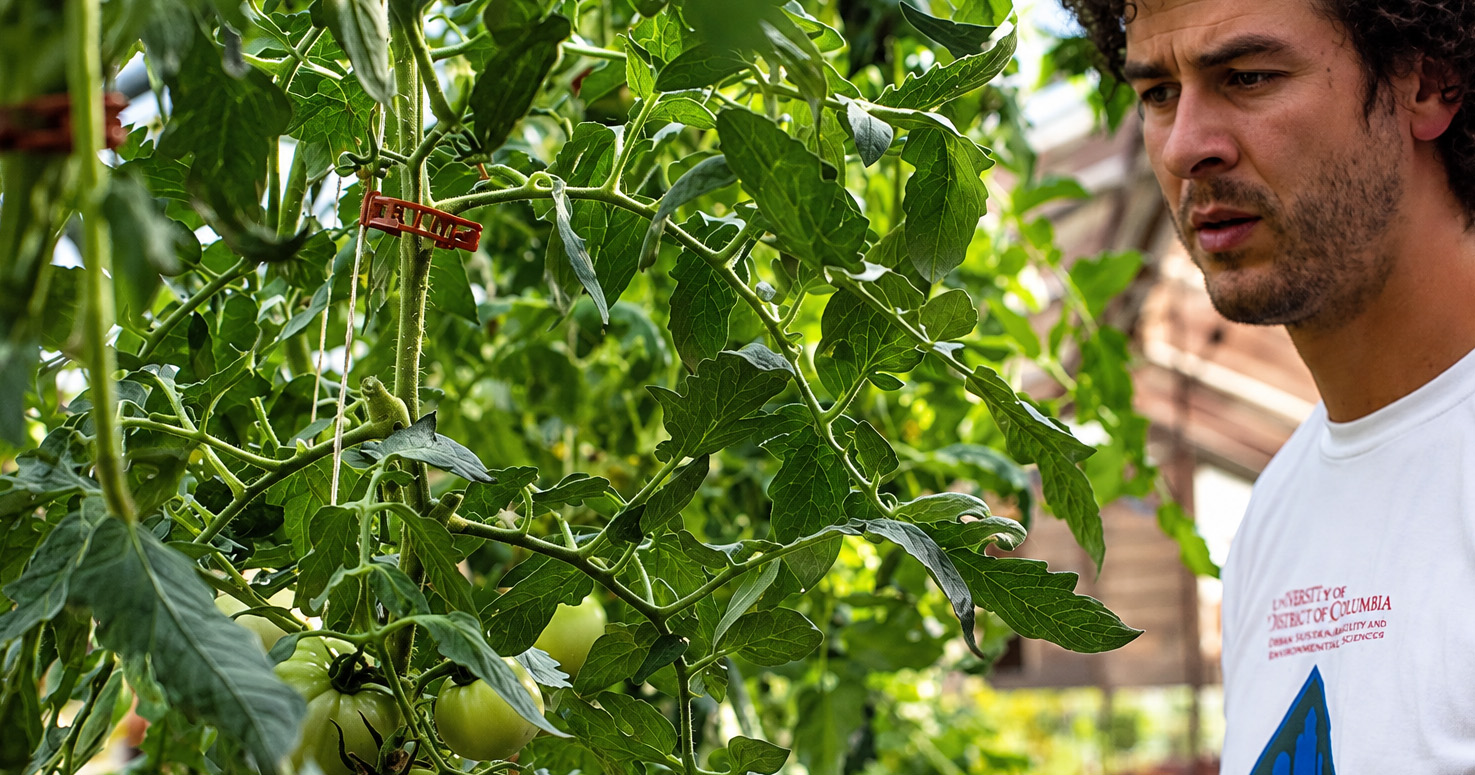
Inside a former closet on the top floor of UDC’s Building 44, plants are helping answer a question with implications far beyond campus: How can cities grow more food while using fewer resources?
The small indoor farm is part of research led by Andy Blunk, who is testing whether dynamically managed LED lighting can reduce the electricity required to grow crops without sacrificing yields. Nearby, another experiment is exploring whether resources produced in the District can be recycled into nutrients for hydroponic agriculture.
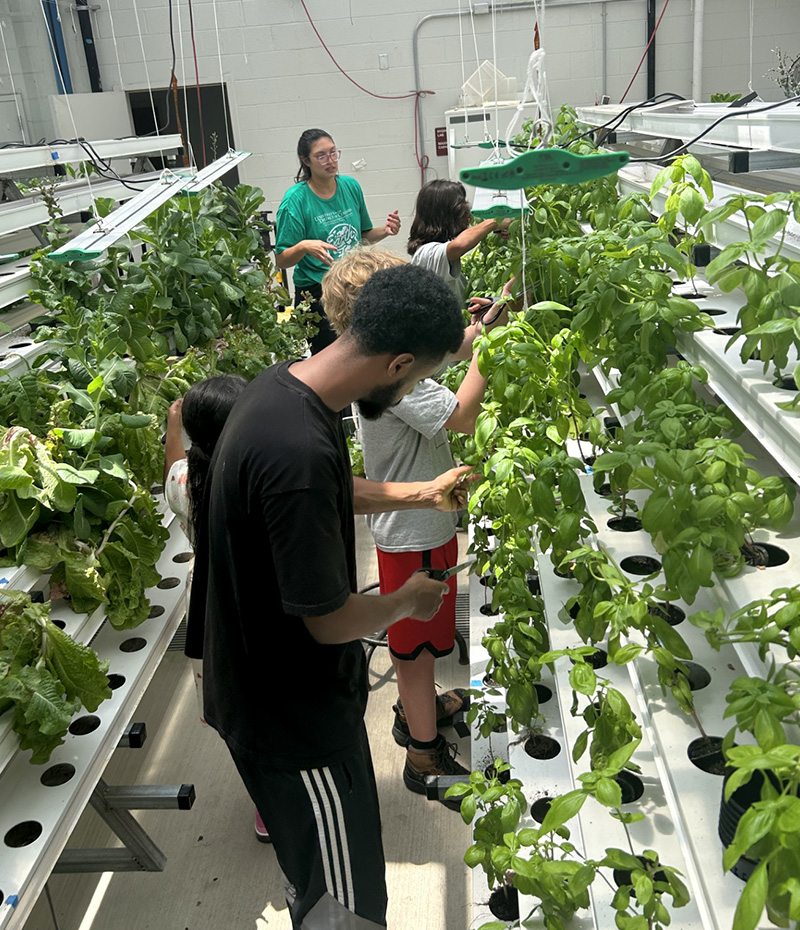
As a project specialist at the Center for Urban Resilience, Innovation and Infrastructure in UDC’s College of Agriculture, Urban Sustainability and Environmental Sciences (CAUSES), Blunk connects teaching, research and community work around a central question: How can cities turn limited space and local resources into opportunities to grow food?
“One of the themes of urban agriculture is [asking] what does the urban environment have that is an opportunity rather than a hurdle,” Blunk explained. For students, finding answers can mean combining agriculture with engineering, computer science, environmental science and entrepreneurship. It can also mean traveling thousands of miles from Washington, DC, to discover how communities elsewhere are solving similar problems.
Blunk teaches an undergraduate and graduate-level course in sustainable and urban agriculture while conducting agricultural engineering and technology research and extension. He describes much of his work as exploring unconventional ways to produce food without soil, from someone growing mushrooms in a basement or microgreens in a closet to larger indoor farms using LED lighting and climate-control technology. Of course, this is especially relevant in cities, where traditional farmland is limited.
Blunk’s path to urban agriculture began with environmental science and a desire to better connect people with natural systems. Agricultural education also runs in his family: His grandfather was a professor of animal science at Virginia Tech, while his mother worked with cooperative extension at Penn State.
After college, Blunk served in the Peace Corps in Ethiopia, working with farmers and developing an appreciation for agrarian communities. He later started his own farm in the United States before returning to graduate school to study plant science. Research comparing hydroponic and conventional growing systems eventually helped lead him toward agricultural engineering and urban farming, and, ultimately, UDC.
Today, that work includes exploring ways to make indoor agriculture more efficient and creating more circular food systems by finding productive uses for resources already available in the city. One UDC study has examined the potential for using compost produced in the District in hydroponics. Another is testing treated biosolids from DC’s wastewater system as an amendment for growing vegetables, comparing the results with conventional hydroponic fertilizers. The goal is to investigate whether materials that might otherwise be considered waste can instead become part of a local food-production cycle.
The research also gives students a chance to rethink what a farm can look like. For example, Blunk’s dynamic-lighting project operates in space that was not originally designed for agriculture, and for him, that is part of the point. “You can set up a farm in a space that isn’t necessarily designed for a farm,” he said.
That shift in thinking can transform an unused room, basement or other indoor space into a potential site for food production, an idea with particular relevance in a densely developed city such as Washington. It also creates opportunities for students well beyond traditional agricultural disciplines.
Blunk works with UDC students studying engineering and computer science who are interested in applying their technical skills to real-world agricultural problems. Indoor and hydroponic farming can require knowledge not just of plant science but also computer science, engineering, energy use and business. Sensors can help farmers manage water. Imaging and other technologies can help identify plant problems. Automated systems can make indoor farms more efficient. That creates space for students who might never have imagined themselves working in agriculture to bring their existing interests into the field.
There is also room for entrepreneurship. Blunk sees unused urban spaces as potential sites for food production if people have the technical and business skills to make those operations viable. Students also need to understand how farms operate and manage costs such as electricity, heating and cooling. All of this interconnected knowledge, Blunk said, can prepare students for a wide range of opportunities. “It’s so interdisciplinary,” he said. “I think that’s one of the exciting parts about it.”
For Blunk, learning how to build more resilient urban food systems also means looking beyond Washington.
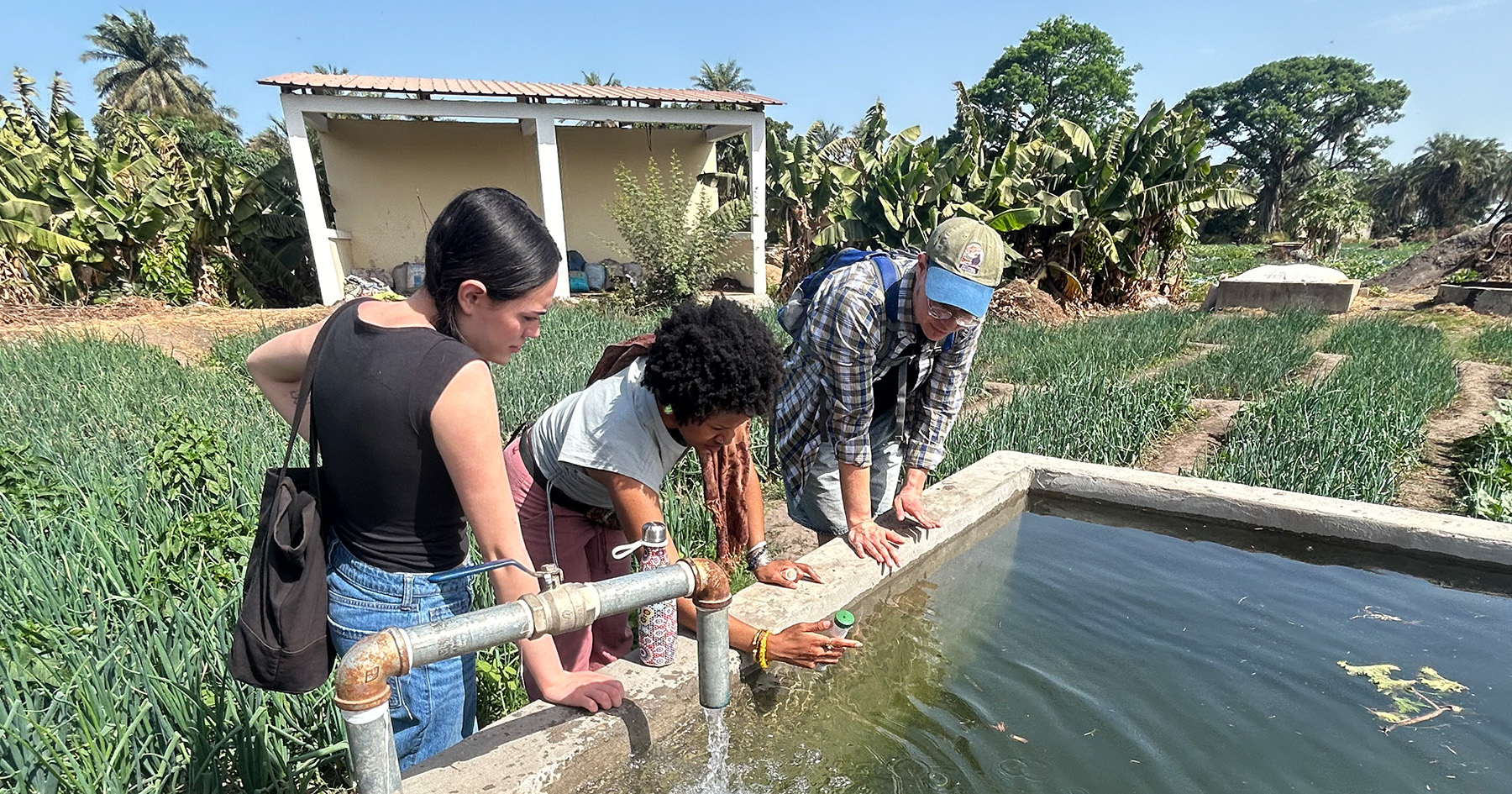
During spring break, he traveled with four UDC students from his sustainable agriculture course to The Gambia for a weeklong exploration of agriculture and food systems. The group visited Ministry of Agriculture sites and urban farms, traveled into the countryside to spend time with farmers and met researchers at the University of The Gambia. Gambian students studying agriculture also joined the UDC group, creating opportunities for students from both countries to learn alongside one another.
The purpose was not simply to observe another country’s agricultural practices. Blunk wanted students to consider what Washington could learn from communities with different relationships to agriculture and natural resources. “The goal was to learn about how The Gambia is approaching urban agriculture, with the idea that there would be best practices that are being done in this very different context where people are closer to their agrarian roots … and don’t have the disconnection a lot of us in the United States and urban environments are having learning for the first time how to grow our food,” Blunk said. “It was the most amazing thing I’ve gotten to do so far.”
The questions students explored in The Gambia also matter in Washington: How can communities produce more food locally, conserve resources and keep food available during environmental or economic disruptions?
For the past two summers, Blunk has helped lead a hydroponics camp that introduces District high school students to growing food without soil. Using UDC’s facilities, students explore how small spaces can support food production. The camp extends the university’s land-grant mission by connecting young people with research that addresses community needs.
For Blunk, the future of agriculture may not begin on vast stretches of farmland. It may begin in places most people overlook: a closet, an unused room or a city block waiting to be reimagined. That is part of what drew Blunk to UDC in the first place — the opportunity to connect research, education and community needs in a city where the future of agriculture is not an abstract question, but something students are helping build today.
Learn more about UDC’s urban agriculture programs, research and experiential learning opportunities