


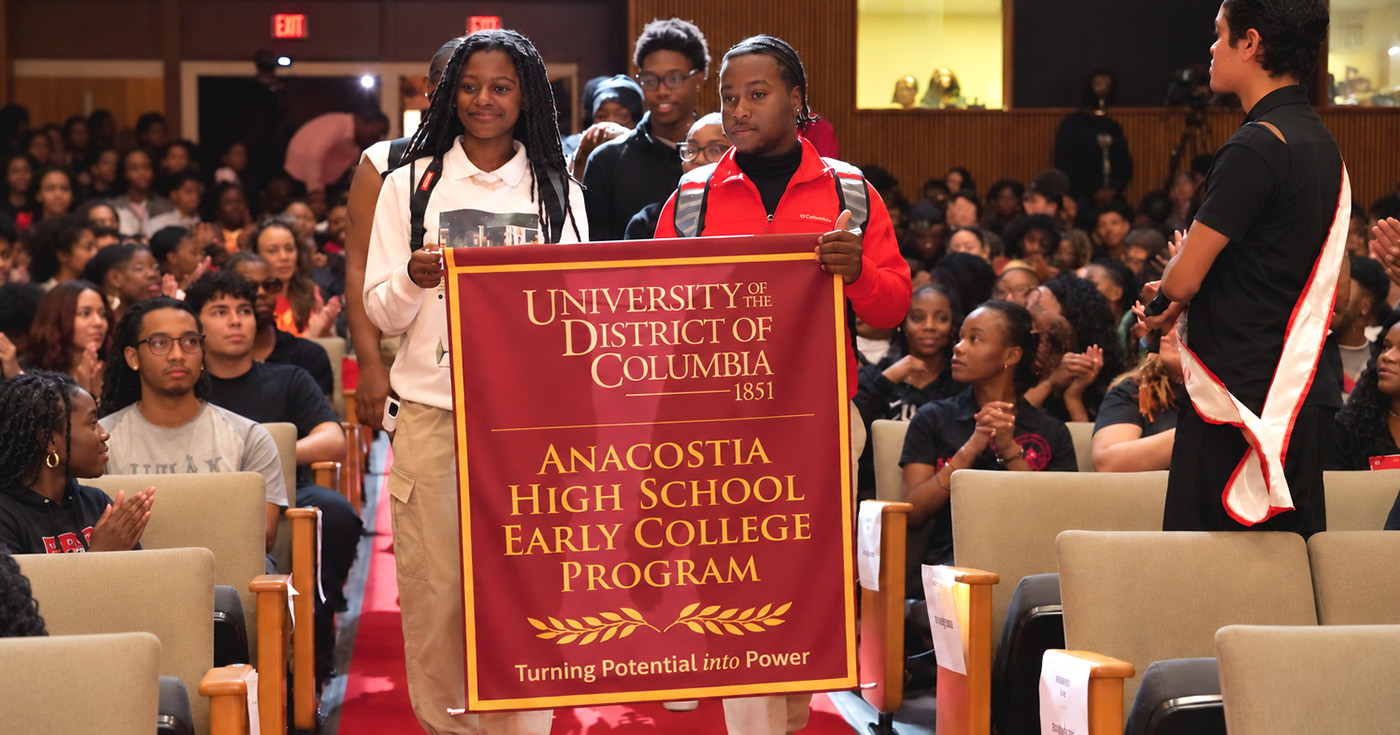
Students from across the University of the District of Columbia filled the Theater of the Arts yesterday for the 2026 Fall Convocation, the ceremonial opening of the new academic year.
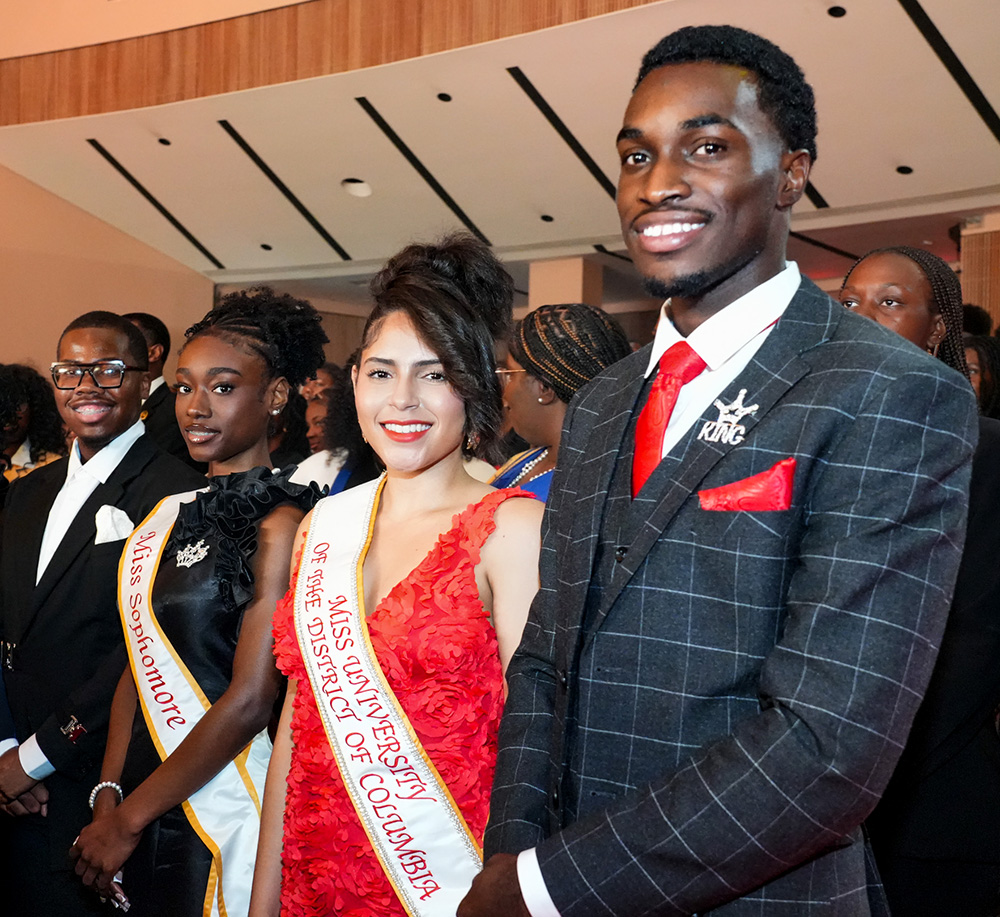 Mr. and Miss UDC led a processional that included members of the Royal Court, student government leaders, Greek organizations, student ambassadors, athletes, nursing students and Metropolitan Police Department cadets. Students from the Anacostia High School Early College Program were there, too.
“It is a place of welcome for the newest members of an academic community and a time of recommitment for those who are returning,” Chief Academic Officer April Massey said in her opening remarks.
More than 1,000 new students joined Firebird Nation this fall. For them, Convocation offered an introduction to UDC as a public, land-grant HBCU in the nation’s capital — and to the faculty, staff and students who bring that identity to life.
“From this stage, on this day, we bridge history and possibility,” Massey said.
President Maurice D. Edington used his Convocation address to speak about what the District should expect from its public university.
“UDC has a responsibility unlike that of any other institution,” Edington said. “We were created to serve the people of the District and to place an excellent, affordable education within reach.”
He outlined four priorities for the university: expanding access, accelerating student success, strengthening UDC’s role as the District’s anchor institution and continuing to build a world-class university.
Admission, Edington said, is only the beginning. Students must also receive the instruction and support they need to persist, graduate and take the next step in their lives and careers.
“UDC belongs to the District, and the District must be able to depend on us,” he said. “Together, we will continue turning potential into power for our students, our university and the communities we serve.”
 That responsibility came into sharper focus during the morning’s Convocation lecture, “A Food System Built to Thrive.”
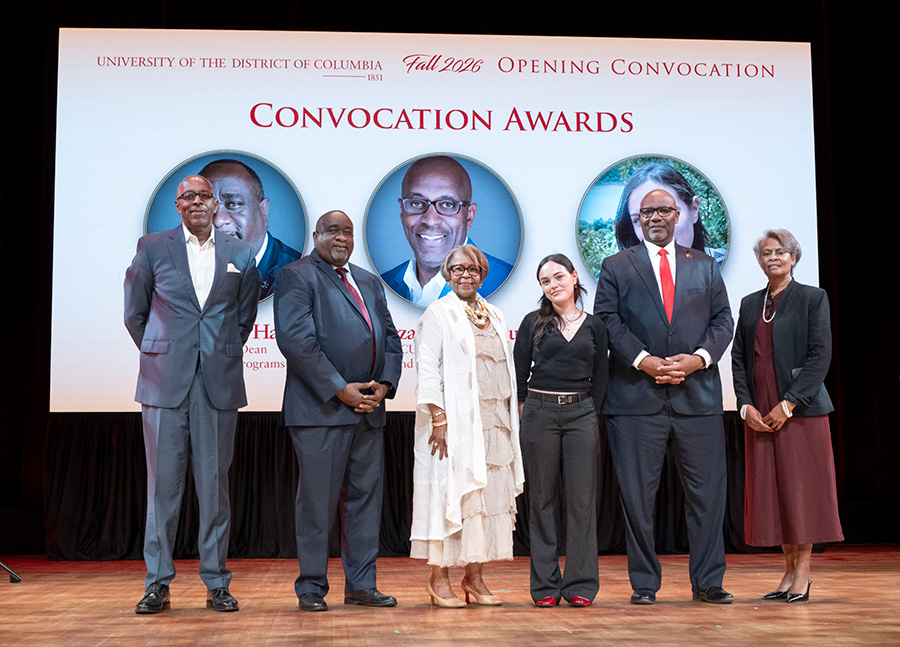
William W. Hare, associate dean for Land-grant Programs in the College of Agriculture, Urban Sustainability and Environmental Sciences (CAUSES), and Mchezaji “Che” Axum, director of the Center for Urban Agriculture and Gardening Education, showed the audience what UDC’s land-grant mission looks like on the ground.
Hare began with the CAUSES Urban Food Hub Model, a closed-loop system that brings together food production, preparation, distribution and waste recovery.
“CAUSES’ Urban Food Hub Model is a closed-loop system with four components: food production; food preparation and value addition; food distribution and marketing; and food and water waste recovery for reuse,” Hare said.
At the center of that system is the 143-acre Firebird Research Farm in Beltsville, Maryland. CAUSES also operates four urban food hubs across the District, with each location serving two wards.
The hubs are places to grow food, but that is only part of the story. They are also classrooms, research sites, workforce-development centers and spaces where UDC faculty and students work alongside DC communities.
Axum walked the audience through the system, beginning at Firebird Research Farm.
“The farm was created as a learning and research lab,” he said. “The farm serves as a backup to the urban food hubs, and all components of the food hub are also at Firebird Research Farm.”
At the Van Ness Urban Food Hub, the work includes soilless crop-production research, green-roof food production, community classrooms, student food pantries, farmers markets and environmental testing.
The Lamond-Riggs Urban Food Hub supports vertical and soil-based food production, a native plant nursery, food preparation and community education. East Capitol Urban Farm and PR Harris Urban Farm extend the work into Wards 6, 7, 2 and 8.
Across the sites, students and faculty take part in seedling propagation, aquaculture, composting, food preparation, beginning-farmer training, environmental stewardship and water-management projects.
The value of that infrastructure became especially clear during the COVID-19 pandemic.
“The COVID-19 pandemic demonstrated that our farms and food hubs are far more than teaching and research sites,” Axum said. “They are vital community assets and an essential part of the District’s food-security infrastructure.”
When access to food was disrupted, CAUSES produced and delivered fresh food to DC residents in need.
“That response is one example of how we are delivering on the promise — using the university’s knowledge, people and resources to meet the District’s most urgent needs,” Axum said.
The farms and food hubs continue to strengthen food security, prepare communities for future emergencies and give students experience they can carry into their careers.
Hare also discussed paid extension and research internships available to undergraduate and graduate students. The project-based opportunities give students hands-on experience while helping them build skills and professional connections.
“These internships often lead to job opportunities and enhance student recruitment and retention,” Hare said.
Senior urban sustainability major Tifanny Baldizon knows the value of that experience firsthand. An intern at Firebird Research Farm, she has worked on hydroponic and aquaponic systems and conducted research on self-provisioning and urban food insecurity.
Baldizon introduced Hare and Axum before their presentation. What she did not know was that she would soon be called back to the stage.
The university surprised her with a $5,000 scholarship. Hare and Axum received a $5,000 award to support their work with students through UDC’s land-grant programs.
“I am so thankful for winning this award,” Baldizon said.
Convocation also made room for another important beginning: UDC’s new Master of Social Work program, which will welcome its first cohort in October.
Several applicants were in the audience and stood to be recognized. Among them was Ayanna Free, a returning student who said Massey’s remarks stayed with her long after they were delivered.
“Convocation felt intentional,” Free said. “Dr. Massey’s words are still echoing in my mind. She touched me as a returning student. I feel a strong connection here and feel that our community is coming together. I am still emotional about it.”
The morning ended with the singing of the Alma Mater and a benediction, but the day’s activities continued with the CAUSES Open House.
There, students moved through exhibits, asked questions and spoke directly with faculty and staff about their research and programs.
Elizabeth Gearin, assistant professor and program coordinator for urban sustainability, walked students through her Urban Foodways Project exhibit. Gearin’s research focuses on sustainable land use, community engagement and biophilia, including urban foodways and park usage.
Amy Schweitzer, a project specialist with the Center for Nutrition, Diet and Health, used a Veggie Meter to measure visitors’ skin carotenoid scores, an indicator of fruit and vegetable intake.
Reflecting on both Convocation and the CAUSES Open House, UDC First Lady Tonya Barge Edington summed up the day simply. “The year is off to a great start,” she said.
For more information about the College of Agriculture, Urban Sustainability and Environmental Sciences, visit udc.edu/causes.