



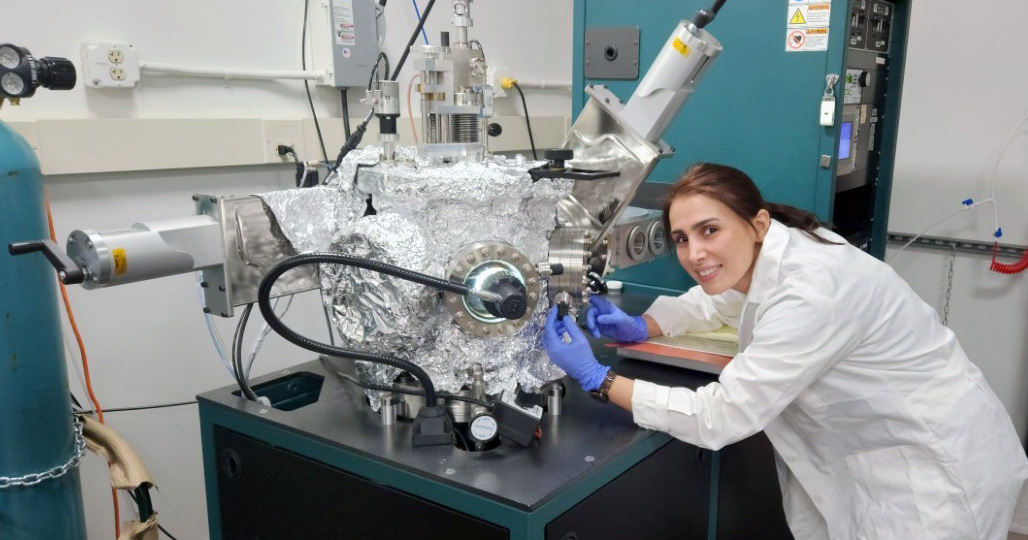
The University of the District of Columbia has secured a $9.9 million competitive federal award through the Research and Education Program for Historically Black Colleges and Universities and Minority-Serving Institutions Pilot Program, a landmark initiative established by Congress to strengthen research capacity at these institutions while supporting their progression toward Carnegie Research 2 (R2) status.
Under the project, “Advancing Research Capacity in Scalable Chemistry-Enabled Quantum Information Device Manufacturing for Institutional Transition from RCU to R2 with a Pathway to R1,” UDC will expand opportunities for faculty and student scholarship, and strengthen research infrastructure to launch novel quantum information science research by leveraging advancements in molecular spintronics device research occurring at UDC.
Over the next five years, the project will establish a nationally competitive research and education program in chemistry-enabled quantum information device manufacturing. Building on UDC’s existing strengths in nanotechnology and molecular spintronics, the initiative will expand interdisciplinary collaboration between engineering and chemistry, strengthen graduate education, enhance shared research infrastructure and accelerate the university’s progress toward Carnegie R2 classification. The project also is expected to increase research productivity through publications, patents, externally funded projects and the preparation of a highly skilled STEM workforce.
“This award is an acknowledgment of the progress UDC has made in building a stronger culture of research and innovation,” said UDC President Maurice D. Edington, who serves as the project’s principal investigator. “As the District’s public university, we are committed to creating opportunities for students and faculty to tackle complex challenges while generating knowledge that benefits our city and our nation. This investment strengthens that work and advances our long-term vision for UDC.”
Established through the FY 2023 National Defense Authorization Act, the pilot program is designed to help HBCUs and other minority-serving institutions build the infrastructure and institutional capabilities needed to expand sponsored research and compete for larger, more complex federal research opportunities.
The award builds on UDC’s growing national research profile, including its 2025 Carnegie Classification as a Research College and University. It advances the university’s long-term goals of expanding sponsored research, strengthening graduate education and creating new opportunities for students to participate in high-impact scientific discovery.
“Research excellence and student success go hand in hand,” said Chief Academic Officer April Massey. “This award expands opportunities for our students, undergraduate, graduate and professional, to gain hands-on research experience, strengthening the university’s ability to transform student learning, recruit outstanding faculty, and support problem solving across the broader DC community. The benefits of these types of investment are long lasting and will benefit our students, our faculty and the university for years to come.”
“I am extremely delighted about this new grant for chemistry-enabled quantum device manufacturing research,” said Devdas Shetty, dean of UDC’s School of Engineering and Applied Sciences. “This award is a significant milestone for our research program and will play a crucial role in advancing quantum device technologies and fundamental research in quantum science. The grant will also strengthen graduate education at UDC by providing outstanding research opportunities for students and fostering the growth of our PhD programs. In addition, it has tremendous potential to increase the number of PhD graduates from SEAS while promoting technology commercialization through active student involvement in cutting-edge research and innovation. We are excited about the opportunities this grant creates to advance scientific discovery, educate the next generation of researchers, and translate breakthrough technologies into real-world applications.”
Scientific leadership for the project will be provided by Professor Pawan Tyagi, director of UDC’s Center for Nanotechnology Research and Education (CNRE), whose work in molecular spintronics and advanced materials has helped establish UDC as an important contributor to next-generation computing research. Tyagi, who has four patents and more than 50 publications in molecular spintronics devices, will lead the interdisciplinary team that strengthens quantum information systems (QIS) research at UDC. CNRE will not only be the location for conducting proposed research but also will host new talent in the QIS field. Approximately six Ph.D. students will be funded to perform cutting-edge research in QIS.
“This project allows us to think beyond foundational molecular spintronics research harnessing industrially mature magnetic tunnel junction technology and build the long-term scientific foundation for discovery in quantum computing devices,” said Tyagi. “It will enable our students and faculty to explore new approaches to quantum information devices while advancing technologies that could shape the future of computing.”