


Hundreds of aspiring young entrepreneurs from across the United States and around the world brought their ideas to the 2026 UDC Capital Cup Entrepreneurship Competition. The annual competition, hosted by the School of Business and Public Administration (SBPA) and supported in part by the National Science Foundation through UDC’s Artificial Intelligence and Robotics (AIR) initiative, challenges high school students to identify real-world problems and develop innovative solutions.
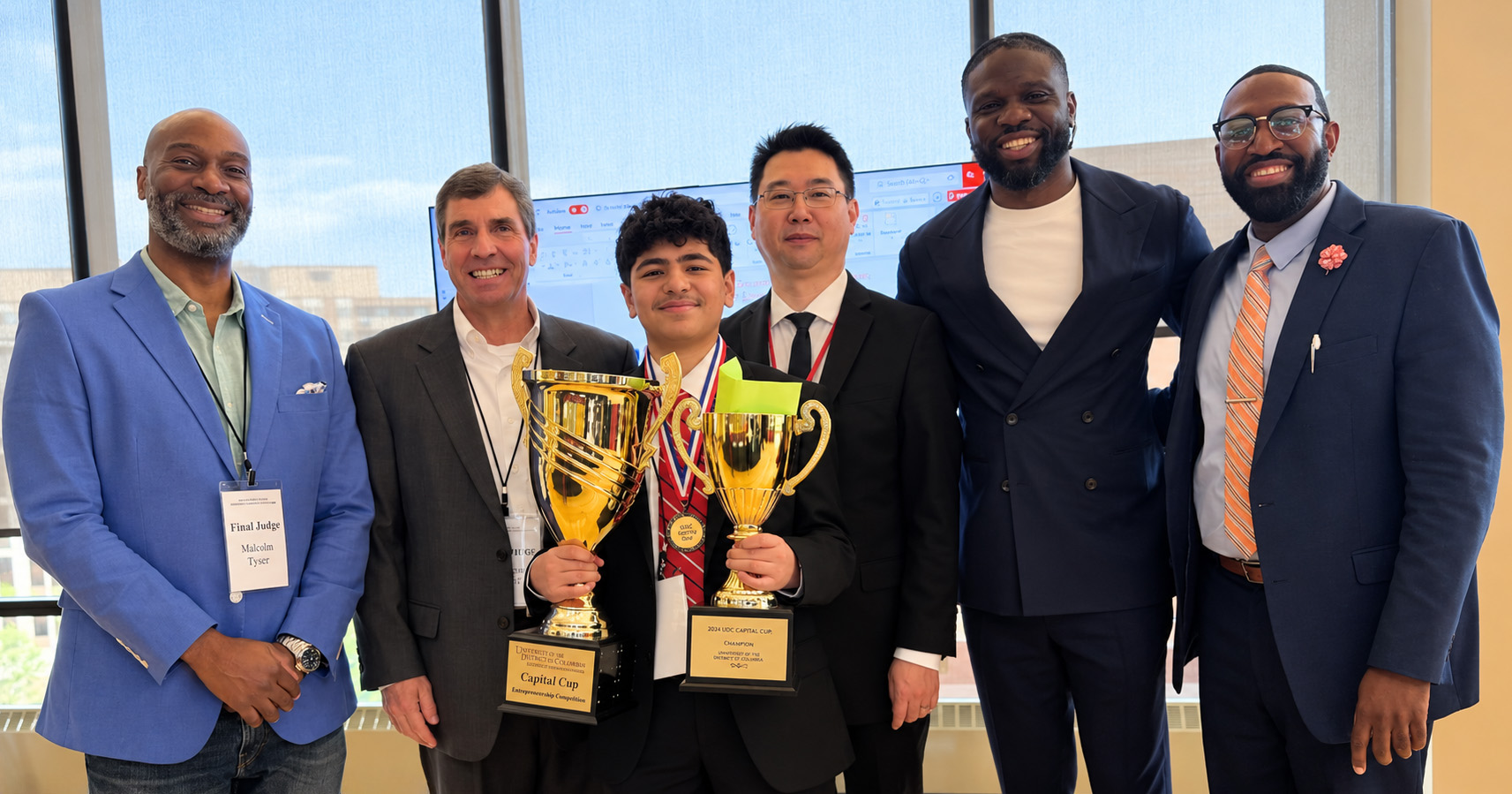
This year’s competition attracted 436 registered teams representing 30 countries, 32 states and the District of Columbia. From that international field, six finalist teams earned the opportunity to present their ideas in person at UDC on Aug. 13. American International School of Kuwait student Karim Fawzy ultimately won first prize for his project, “AeroVein.” Runners-up were Medha Lalani and Reshma Lalani from Hempfield High School in Landisville, Pennsylvania, with “Tech Buddies”; Raina Swaminathan and Anishva Manikandan from South Forsyth High School in Cumming, Georgia, with “Neurolink”; Aiden Jacob from Allen High School in Allen, Texas, with “DREVN”; Aditya Raja, Ishan Kasam and Dhruv Vasishta from Holliston High School, Mass Academy and Malden Catholic High School, all in Massachusetts, with “Whale Safe AI”; and Ananya Desai from William Mason High School in Mason, Ohio, with “BloodConnect Offline.”
The UDC Capital Cup always benefits from the strong professional engagement of industry and community leaders. This year, TEDCO Chief Federal Engagement Officer Stephen Auvil, HBCU Buzz founder and CEO Luke Lawal Jr., StratAscension founder and managing director Malcolm G. Tyson and City Year senior vice president and executive director Selvon Malcolm Waldron served as judges for the final round. Nasir C. Qadree, founder and managing partner of Zeal Capital Partners, and Carolyn B. Rudd, founder, president and CEO of CRP, Incorporated, and vice chair of UDC’s Board of Trustees, were on hand to present certificates and prizes to all six finalist teams.
After the finalists’ presentations, SBPA Professors Amit Arora and Anshu Arora gave a robotics and artificial intelligence demonstration. The demonstration highlighted UDC’s Robotics and Artificial Intelligence concentration, an interdisciplinary program created by SBPA last year with support from a National Science Foundation Targeted Infusion Project grant. Open to students from all majors, the concentration gives UDC students across disciplines new tools for innovation.
For UDC, the Capital Cup is an opportunity to introduce talented high school students to the university while demonstrating how entrepreneurship can transform ideas into action.
“The impact goes beyond one competition,” said SBPA professor and graduate MBA program director Jian Hua, the founder and director of the UDC Capital Cup Entrepreneurship Competition. “For many participants and their families, the Capital Cup may be their first meaningful interaction with UDC.”
Through the competition, participants and their families encounter a university that emphasizes innovation, entrepreneurship and access to opportunity, while UDC builds connections with prospective students, families, schools, entrepreneurs, business leaders and community partners.
The international reach of this year’s competition also demonstrates how an institution rooted in Washington, DC, can create educational opportunities with impact far beyond the District.
“As a public HBCU located in the nation’s capital, UDC is especially well positioned to create opportunities that connect education, entrepreneurship and economic development,” Hua said. “I hope the Capital Cup can continue to strengthen UDC’s visibility and become a signature entrepreneurship program that students around the world recognize.”
The competition also reflects the approach to business education that UDC brings to its own students.
Developing a successful business idea requires more than creativity. As Hua explained, entrepreneurship requires students to identify a need, develop an innovative solution, understand customers and markets, evaluate financial feasibility, communicate effectively and defend their ideas. Those are many of the same skills UDC business students develop as they learn to apply concepts from the classroom to real-world challenges.
“When [Capital Cup participants] develop a business idea and present it before experienced judges, they begin to see themselves not simply as students, but as innovators, entrepreneurs and future business leaders,” Hua said. “That is the same mindset we want to encourage among our UDC students.”
The experience creates a bridge between secondary and higher education while introducing participants to skills that extend beyond entrepreneurship. Developing an idea, working through challenges and presenting a solution can build confidence, creativity, leadership and critical-thinking skills that students can carry into college and future careers.
That development is ultimately more important than determining which team takes home the Capital Cup.
“For me, the Capital Cup is not simply about determining who finishes first,” Hua said. “It is about giving young people a serious platform for their ideas and showing them that their creativity and entrepreneurial ambitions matter.”
For UDC, providing a stage for those ideas is part of the university’s broader commitment to expanding educational opportunity and helping young people see themselves as capable of addressing the challenges around them.
And whether those students ultimately pursue business, technology, public service or another field, Hua hopes their experience at UDC leaves them with something that lasts beyond the competition.
“If they leave UDC believing that they can build something, solve a problem, or become an entrepreneur, then the competition has accomplished something meaningful.”