


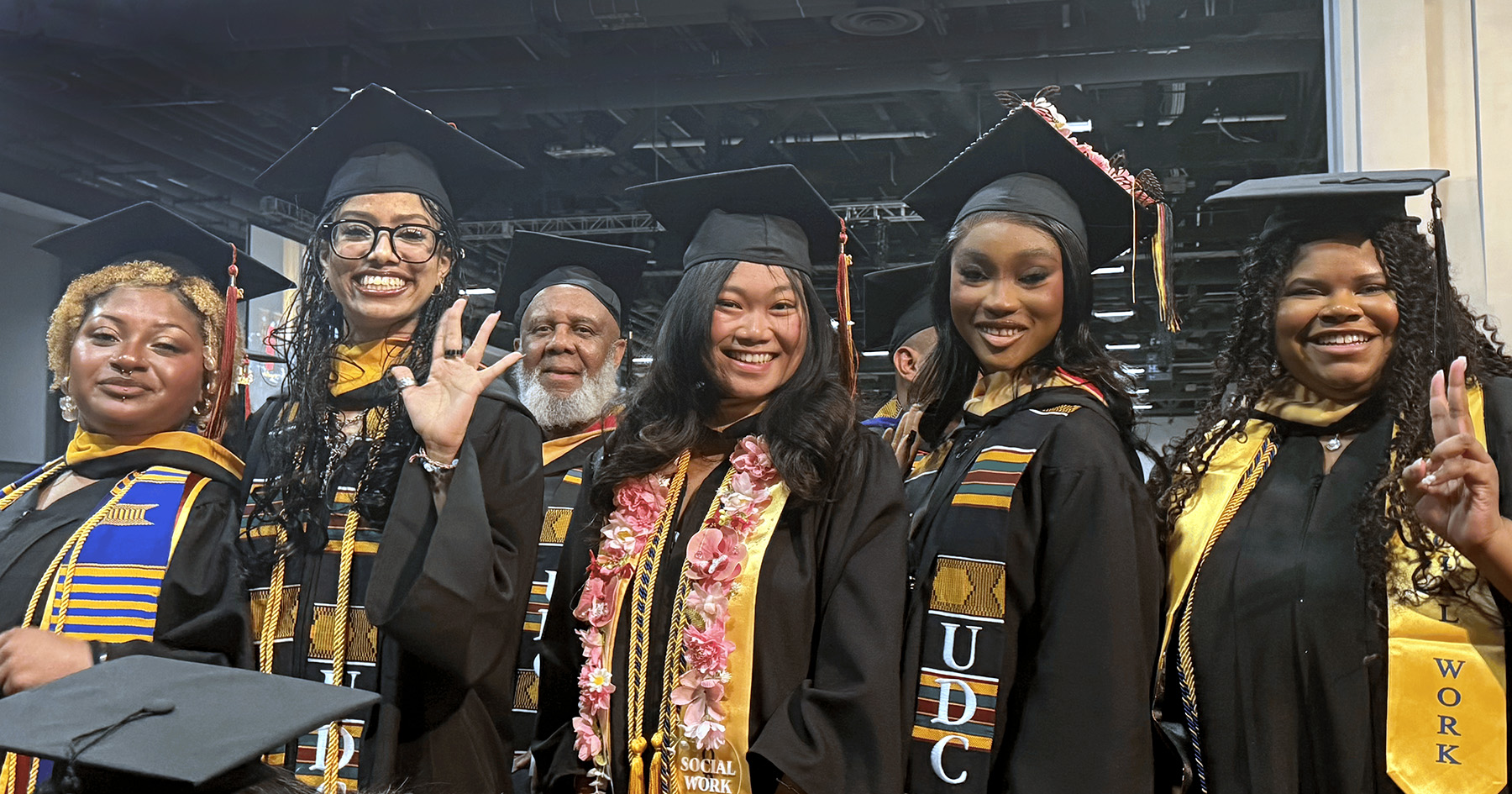
The University of the District of Columbia is proud to announce the official launch of its Master of Social Work (MSW) program, creating a new pathway for students to earn an advanced degree, pursue professional licensure and build careers serving communities across the region.
The MSW program supports the goals of the Pathways to Behavioral Health Degrees Act of 2023, which the DC Council approved in fall 2023 and took effect Jan. 23, 2024. The program seeks to strengthen the local behavioral health workforce and reduce financial barriers for District residents pursuing qualifying graduate degrees. The 2023 measure also established a scholarship program that can provide eligible UDC students with assistance for some or all of the following: tuition, books and supplies, living and transportation expenses, professional licensure costs.
“Our new MSW program reflects exactly what it means for UDC to serve as the District’s public university and workforce engine,” said President Maurice D. Edington. “Aligning what we do as a university with the District’s needs and goals is at the heart of our strategic vision. When District leaders identify a critical workforce need, UDC is ready to be part of the solution. By preparing talented residents for careers in social work and behavioral health, we are not only expanding economic opportunity but also strengthening the network of support services our neighbors, schools, families and communities need to thrive.”
The new MSW program is designed specifically around the challenges and opportunities of social work in urban communities. Students will complete 900 hours of supervised practicum experience over two years, including hands-on experience in a wide variety of behavioral health agencies and settings, including schools, hospitals, nonprofits, government agencies and advocacy organizations.
Students may choose specialized tracks in civic and community engagement or trauma prevention, intervention and recovery, with concentration areas in urban environmental social work, political social work, family and community violence or substance abuse prevention, intervention and recovery.
“At UDC, we pride ourselves on academic programs that are both rigorous and responsive,” said Chief Academic Officer April Massey. “The MSW program was developed with a clear understanding of the District’s workforce needs as well as the complex environments in which today’s social workers practice. Students will combine strong academic preparation with extensive field experience so that they graduate ready to serve, to lead and to make a meaningful contribution to the organizations and communities that depend on them.”
Experiential learning is woven throughout the program through community- and policy-focused projects, case-and simulation-based learning, interdisciplinary collaboration, advocacy and civic engagement, and research-informed practice. With an anticipated student-to-faculty ratio of approximately 12-to-1, students will also receive individualized instruction and mentorship from experienced social work faculty.
“We have built a program that prepares students to understand social work not in isolation, but in the context of the systems and communities that shape people’s lives,” said MSW Program Director Kesslyn Brade Stennis. “Our students will explore the many connections between behavioral health, housing, education, policy, community and family systems, while gaining the practical experience necessary to address those issues effectively. Washington, DC is not simply where our program is located — it is an essential part of how our students will learn to practice.”
Under the scholarship established by the 2023 Pathways to Behavioral Health Degrees Act, eligible District residents enrolled in qualifying graduate programs at UDC may receive financial assistance in exchange for a commitment to work in the District after completing their degree and obtaining the required professional license or certification. Participants receiving program assistance commit to three years of employment with a District government or local education agency, or a qualifying health care organization.
National demand for social workers also remains strong. The US Bureau of Labor Statistics projects that employment of social workers will grow 6% from 2024 to 2034, faster than the average for all occupations. Graduates of UDC’s program will be prepared to pursue careers in behavioral health and substance use treatment; child, family and school services; health care and trauma response; government and legislative affairs; and advocacy and community-based organizations.