



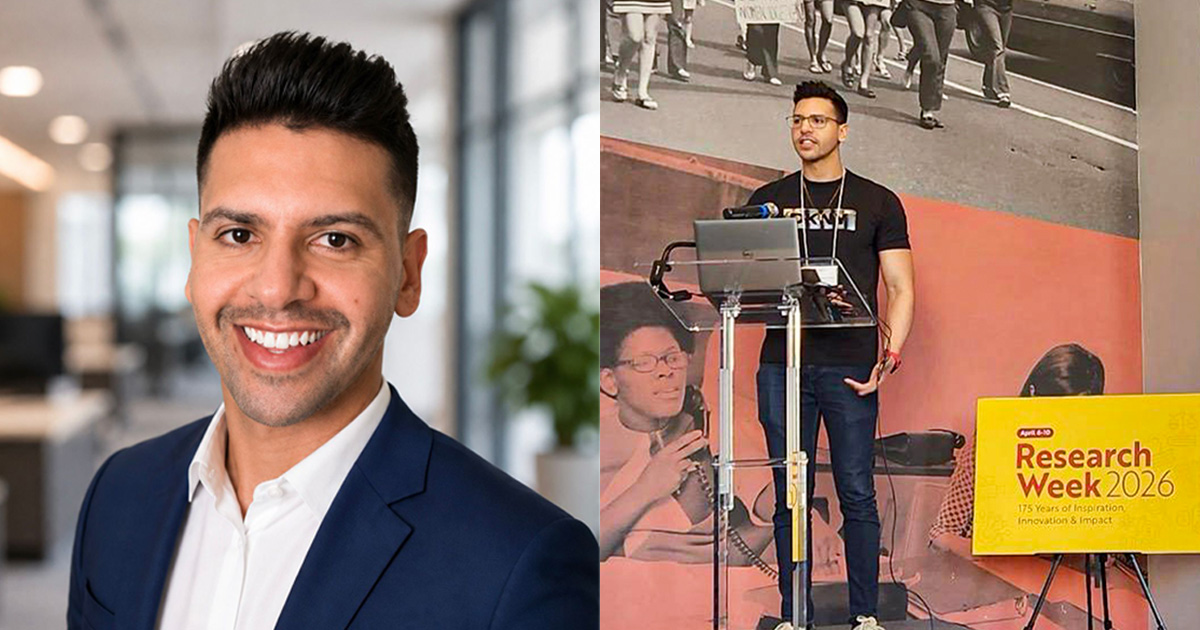
Recent University of the District of Columbia Master of Architecture graduate Cesar Borges dos Santos has earned the American Institute of Architects (AIA) Medal for Academic Excellence, a distinguished honor awarded each year to the top-ranking graduating students with a Bachelor of Architecture, Master of Architecture, or Doctor of Architecture from schools accredited by the National Architectural Accrediting Board (NAAB) or Canadian Architectural Certification Board (CACB). Selected by faculty at individual universities, it recognizes the graduating student who has displayed the highest overall academic excellence and general excellence in architecture.
For Santos, the recognition celebrates years of research, design exploration and a commitment to using architecture to address complex social challenges. His exceptional leadership, academic ability and design talents shone through his thesis, “Redefining Spaces for Animal Welfare: Spatial Strategies for Stray Dog Management in Brazil,” where he proposed an innovative architectural solution for improving animal and community health. His contributions reflect UDC’s highest standards for academic achievement and commitment to building community capacity, and his achievement reflects both his dedication as a student and the university's commitment to preparing architects who approach design as a tool for positive change.
The inspiration for Santos’ thesis emerged from a deep personal experience.
“Growing up in Brazil, I witnessed firsthand the large population of stray dogs, many of them living without proper care or access to basic necessities,” Santos said. “While this had always stayed with me, it was during my last trip to Brazil in 2024 that my passion turned into a purpose. I came across a stray dog that was severely sick, neglected and left to die. That moment had a profound impact on me and sparked the idea for my thesis.”
The experience prompted Santos to explore how architecture could help address an issue affecting many global communities.
“Seeing that reality inspired me to explore how architecture could become part of the solution,” he said. “My goal was to promote awareness of this issue and propose a humane, community-centered shelter model that could help mitigate the stray dog crisis. While this problem is uncommon in North America, it remains widespread throughout much of South America. Architecture has the power to improve not only the built environment but also the well-being of both communities and animals.”
Rather than focusing solely on a building, Santos developed a research-driven project examining the broader social, environmental and public health implications of the issue.
Santos said his project’s interdisciplinary approach helped distinguish him among architecture students nationwide.

Redefining Spaces for Animal Welfare: Spatial Strategies for Stray Dog Management in Brazil





“The project earned national recognition because it was deeply rooted in research and addressed an issue that is often overlooked within the field of architecture,” Santos said. “My work focused on understanding the underlying causes of stray dog overpopulation in Brazil and across much of South America. I believe that understanding the root causes of a problem is essential to developing thoughtful, technically sound and research-driven solutions.”
The project’s impact extended beyond architecture alone.
“Beyond proposing a building, my thesis sought to raise awareness of the issue while presenting an architectural model that could help reduce stray dog populations through humane, community-centered design,” he said. “By integrating architecture, public health, animal welfare, urban planning and community engagement, the project demonstrated how design can contribute to solving complex societal challenges.”
In addition to receiving the AIA Medal for Academic Excellence, Santos was also selected as an AIAS CRIT Scholar, a national fellowship that supports architecture students whose thesis work demonstrates exceptional research, innovation and impact. This fellowship also provides mentorship from accomplished architects and financial support to help offset research-related expenses, creating valuable opportunities for both professional and academic growth.
Santos credits UDC’s architecture program, where he also earned his Bachelor of Science in Architecture in 2024, with helping him develop the skills necessary to succeed both academically and professionally.
“UDC prepared me for success by challenging me to think critically, approach design through research and view architecture as a tool to address real-world challenges,” Santos said. “Throughout both my undergraduate and graduate education, I developed the technical, analytical and communication skills that prepared me for the next stage of my professional career.”
He also emphasized the role of faculty mentorship throughout his academic journey.
“I am especially grateful to Dr. Anna Franz, associate dean of Academic Affairs and Student Success, and Dr. Kirsten Kinzer, department chair and associate professor, who served as my thesis advisors and continuously challenged me to strengthen both my research and design throughout the thesis process,” Santos said. “I am also thankful to the UDC School of Architecture faculty, whose dedication and mentorship throughout my academic journey encouraged me to push my limits and become the best version of myself as a designer and professional.”
Faculty members say Santos’ work shows how architecture can address real-world challenges. As Kinzer put it, “Cesar’s Master of Architecture thesis is unique because it frames stray dog management as an architectural and spatial design problem, rather than solely as a public health, veterinary or policy issue. By applying a value-inclusive design framework, Cesar connected animal welfare, community well-being, sustainability and accessibility in a single design response. It was a joy to watch Cesar move from a vague idea that stray dogs are a problem in Brazilian cities to a fully realized architectural solution.”
His achievement also highlights the strength of UDC’s architecture program and its focus on preparing students to make meaningful contributions to the profession. Franz said: “We are extremely proud of Cesar as an AIA award is the ultimate acknowledgment of impactful, exemplary work in architecture and design—setting new standards of excellence, opening new doors and inspiring others to innovate.”
As he begins his professional career, Santos plans to pursue architectural licensure while continuing to design projects that positively impact communities and advocate for animal welfare.
“I look forward to continuing my professional journey in architecture by further developing the design skills I gained at UDC while contributing to meaningful projects that positively impact communities,” he said. “One of my long-term goals is to become a licensed architect in the United States by completing the Architectural Experience Program (AXP) and passing the six divisions of the Architect Registration Examination (ARE).”
He also hopes to support future generations of architecture students.
“Beyond my professional growth, I hope to mentor future architecture students by sharing the guidance, encouragement and experiences that helped shape my own journey at UDC,” Santos said. “I would love the opportunity to help others become the best students—and future professionals—they can be, just as so many mentors did for me.”
For Santos, these recent honors underscore a conviction that has guided his academic work from the beginning.
“Receiving national recognition has reinforced my belief that architecture extends far beyond creating buildings—it has the power to improve lives, strengthen communities and address meaningful societal issues,” Santos says. “I look forward to carrying that philosophy throughout my career.”
As Santos enters the profession, his nationally recognized work demonstrates how architecture can address challenges that extend well beyond the built environment. Through rigorous research, innovative design and a commitment to community impact, he has shown how architects can help solve complex societal problems. His achievement reflects both his personal excellence and UDC's commitment to preparing graduates who use design in service of the public good.