


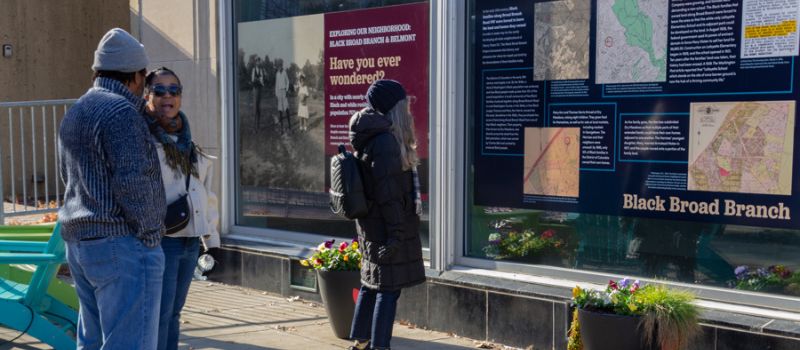
UDC Political Science Associate Professor Amanda Huron launched a history exhibit last month in the Pepco gallery windows at the Harrison Substation of Friendship Heights that details the stories of two early 20th-century Black families in the neighborhood.
The exhibit is entitled “Exploring our Neighborhood: Black Broad Branch & Belmont,” The first part of the exhibit tells the stories of two Black families along Broad Branch Road NW who were forced off their land and out of their homes to make way for the all-white neighborhood development of Chevy Chase.
The second part of the exhibit explores the stories of four Black businessmen who tried to build a modern high-class suburb for Blacks on 30 acres of land in Friendship Heights, Md., called Belmont. They sold lots to at least 28 other Blacks to build homes on before they were stopped. Their story explains why DC suburbs look the way they do today, according to the Friendship Heights Alliance, which spearheaded the project.
The exhibit opened to the public on December 9 and will run through late 2024.
The exhibit is a collaboration between UDC, the DC History Center, and local historians. Each year, the Friendship Heights Alliance sponsors local historians, students and artists to produce public works exploring the stories of the neighborhood.
Huron was asked to put together the Black Broad Branch exhibit. She and two of her former students – UDC Political Science alumni Mariana Barros-Titus and Corey Shaw – worked on the exhibit.
The Black Broad Branch project began because of a conversation between the Historic Chevy Chase D.C. organization’s Board members – Tanya Hardy and James Fisher, who realized that Fisher was a direct descendant of Captain George Pointer.
Meanwhile, historians Barbara Boyle Torrey and Clara Myrick Green were working on a book about the history of the Pointer family, titled, “Between Freedom and Equality: the History of an African American Family in Washington, D.C.”
The Historic Chevy Chase D.C. organization, which was working with Torrey and Green to uncover the Black history of the neighborhood, reached out to Professor Huron about doing a student project on it.
After securing a grant from HumanitiesDC to create a project called, “Black Land Loss in Washington: Memories of the Past, Hopes for the Future,” in partnership with Historic Chevy Chase D.C., Huron taught a class at UDC called “Black Land Lossin Washington” in spring 2021 with oral historian Benji de la Piedra.
They taught students about the history of Black land theft, along with oral history methods, and tasked the students with conducting oral histories with eight descendants of two families whose land off Broad Branch Road was seized to build Lafayette Elementary School and park in the 1920s. The project continued into summer 2021, when 14 D.C. high school students joined the UDC research team.
The Black Broad Branch exhibit is part of an ongoing effort to educate people about the Black Broad Branch story following the descendants’ wishes.
“When my students interviewed the descendants of the families whose land was taken, they found that one of the main things the descendants wanted was for their history to be more widely known,” Huron said. “Making this history public is, for the descendants, part of a larger reparations project. So we were delighted that Friendship Heights Alliance asked us to help create this exhibit on Black history in upper Northwest D.C. – and that the exhibit itself is not just educational, but beautiful.”