


The University of the District of Columbia’s Nursing Program has a long history of serving the District with well-educated students. UDC is keeping pace with the national demand for nurses and healthcare professionals. The University offers two paths to fill the shortages in the medical field through its Registered Nurse to Bachelor of Science in Nursing (RN-BSN) and the Associate of Applied Science in Nursing (AASN) degree offered through the UDC Community College.
Students enrolled in the RN-BSN program are registered nurses. The program builds on their prior learning experiences from the AASN degree and focuses on community, population and community health.
The Accreditation Commission accredits both programs for Education in Nursing (ACEN). Hybrid since 2011, most of the instruction for the RN-BSN has been online, along with practicum learning experiences on campus for hands-on interaction.
The RN-BSN program is located on the UDC main campus and allows registered nurses to gain their bachelor’s degree while working full-time.
The Associate of Applied Science in Nursing degree program is located at the Bertie Backus campus at the UDC Community College.
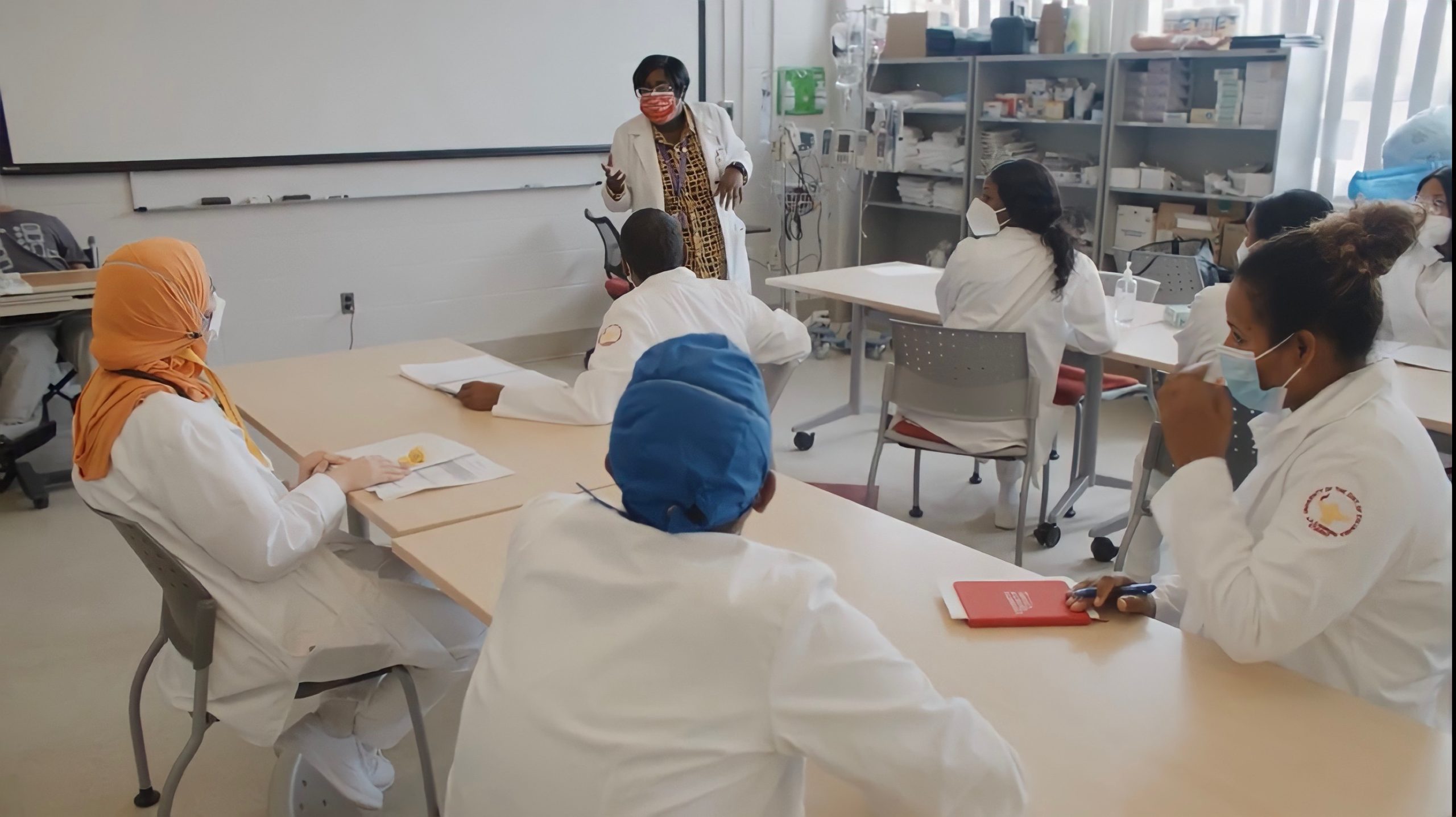
Students in the nursing programs gain access to state-of-the-art training and mentors who guide them in their careers and community commitments. Learning activities are based on real-life scenarios for patient care and healthcare systems. Students are also trained to address ethical issues in health care and nursing system leadership.
Nursing students are challenged with seeking solutions to address health disparities in the District and surrounding communities. Students in the associate degree program typically work in acute care, hospital settings, facilities and home healthcare.
In 2012, the RN-BSN program became a part of the College of Agriculture, Urban Sustainability and Environmental Sciences (CAUSES). In the program, students typically work in the community and places like the Department of Health, school districts, and hospitals. They focus on policies and practices and issues impacting general health, care for the elderly, and school system meal programs.
The programs are under new leadership. Sharon Beasley, Ph.D., RN, CNE, NEA-BC, was recently appointed as the director of Nursing Education and brings a broad perspective on nursing curriculum preparation, education, and accreditation requirements.
Her prior position was director of the Accreditation Commission for Education in Nursing (ACEN), based in Atlanta, Georgia. Her experience includes working as a faculty member, program director of nursing programs and ACEN Director. Beasley earned a Ph.D. in Education from the University of South Carolina and a Master of Science in Nursing Administration from Armstrong Atlantic State University, Savannah, Georgia. She has been a registered nurse since 1997.
She is responsible for helping to ensure that UDC meets the District of Columbia Board of Nursing and the ACEN professional standards and that students are provided quality instruction and a supportive environment that will help lead them to successful careers in nursing.
With recruitment as a top priority, Beasley plans to collaborate with D.C. schools, neighboring community colleges and current UDC students.
“I look forward to helping UDC establish a premier nursing program built upon informed leadership, solid standards, caring faculty, and the desire of students who are called to this special service to succeed,” Beasley said. “The uniqueness at UDC is that we have a link to agriculture and nutrition through CAUSES. In terms of nursing at the baccalaureate level, we assess the community, including water systems and avenues for health maintenance. We have patients who don’t have healthy water; we look at their food sources and opportunities for partnerships.”
Beasley says she hopes enrollment in the programs will grow.
“My initial focus is on UDC’s Nursing program being a place where you go or send your family member, that it’s not the other option. It’s the place to go.”
UDC’s Nursing program has adapted throughout the years to meet the needs of D.C. residents from its beginnings with the merger in 1976 of three predecessor institutions: the Washington Technical Institution (WTI), Federal City College (FCC) and the District of Columbia Teachers College (DCTC). The associate degree program began at the Washington Technical Institution in 1966, and the baccalaureate degree started at the Federal City College in 1968.
UDC remains one of two Historically Black Colleges and Universities (HBCUs) in D.C. with nursing education programs. It provides a significant pipeline of educated professionals to District and regional hospitals and facilities.
UDC’s Nursing Programs are accredited by the Accreditation Commission for Education in Nursing (ACEN). The RN to BSN is scheduled for a site visit in the spring of 2023, and the UDC Community College AASN program has a site visit in 2024.
“Accreditation is a faculty-driven process,” Beasley said. “They have to be involved in it. When teams come, they meet with faculty—they spend about two hours on all our standards. In preparation, small groups of faculty are responsible for some logistical aspects. We are compartmentalizing a large project. It’s a very eye-opening process. It provides a better view of the program to determine the quality and what’s working and what needs to be improved.”
UDC Nursing programs provide a significant pipeline of trained professionals to District and regional hospitals and facilities. Graduates of the program help to increase diversity in the profession and work to improve the health of residents in the DMV.
Upon graduating from the AASN program, nursing students appear for their licensure examination, the NCLEX-RN®, administered by the National Council Licensure Examination. The program at UDC-CC has an 88 percent NCLEX-RN pass rate for first-time test takers.
“UDC-CC is a major hub for the citizens of the District, and local hospitals pay close attention to the quality of education and training that students receive,” said Bushra Ahmad Saeed, Ph.D., division director, Nursing, Allied Health, Life and Physical Sciences (NAHLPS), UDC-CC.
The Associate of Applied Science in Nursing curriculum reflects high standards of professional practice and incorporates guidelines from practice trends, professional organizations and accrediting agencies. Nurses treat patients of all ages and health statuses—from premature infants to the aged in critical care, acute care, rehabilitation, and home care settings.
Beasley said she is committed to strengthening collaboration efforts within the nursing programs, the university, public schools, community colleges, hospitals, and the broader healthcare industry.
“I want the community to recognize our programs as being premier,” Beasley said. “I want the community to recognize that after our students complete their programs, they contribute to the gross domestic product of the DMV. They stay and work in the area. Our graduates are vested in the community.”