


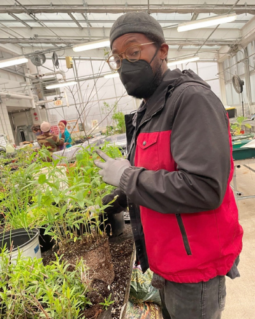
Growing what you eat has always fascinated Michael Bunn as a boy watching his aunt use her skills from South Carolina to transform a D.C. garden into a food oasis. Bunn and his sister, Kyra Moore, set out to expand their options by growing their fruit and vegetables after completing the D.C. Master Gardener Volunteer Training Program.
“One of the main things that the Master Gardener program focuses on is spreading knowledge to support food deserts areas,” Bunn said. “It’s heavily focused on community gardens to help in areas where people have very little access to options other than prepackaged foods with lots of sodium.”
After applying for a garden location with the D.C. Department of Recreation, Bunn and his sister planted three gardens in D.C., including tomatoes, cucumbers, radishes, herbs and plants. His gardens have yielded enough to sell and share with family and friends.
“I’m mostly interested in ensuring we have access,” Bunn said. “Most people don’t know what’s in their food or what’s being put on it. The small investment of time of missing one or two TV shows to spend time in a garden to make sure you have fresh vegetables and herbs is worth it.”
Bunn said he stumbled upon the program while seeking more information about gardening. “I was familiar with CAUSES, but the Master Gardener sparked my interest,” he said. “I’m not a vegetarian, I was looking to eat more vegetables, and I prefer them to be fresh and as chemical-free as possible. Beyond that, it’s an environmental thing. I don’t like to think of the earth being dug up again and again nor the miles required to transport food. We all have to begin to think about where our food is coming from.”
After gaining success as a Master Gardener, Bunn enrolled in the UDC Community College and will continue to earn his bachelor’s degree in Architecture and Landscaping at UDC.
“It’s about credibility,” he said. “When people ask questions, I want to be able to give them solid answers. I live in a city where most people have a degree. I want to have all my credentials to speak officially.”
Bunn says his work as a program manager at a nonprofit, Master Gardener certification and his bachelor’s degree will help him accomplish his long-term goal of owning a nursery in D.C.
“My goal is to have a small nursery in the N.E. community where I was born and raised,” he said. “There isn’t a brick-and-mortar nursery in this community with high-quality plants. My focus is to get as much education as possible to accomplish my goal.”
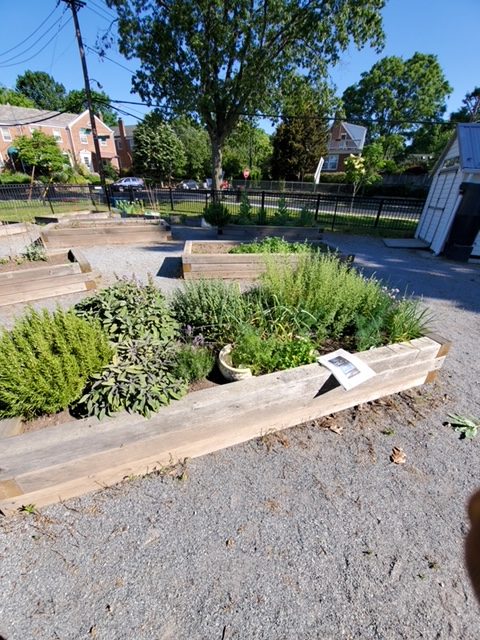
The D.C. Master Gardener volunteer training program is designed to help create sustainable urban gardening practices, where participants go on to volunteer in their communities and provide support to a wide range of garden-based projects and activities.
Volunteers are taught horticultural practices, landscape problem solving, and vegetable and ornamental growing. The content is driven by the priorities of D.C. residents and is accessible to residents in all eight Wards. Participants learn about soil, botany, plant pathology, entomology, Integrated Pest Management, garden planning and compost, water management and conservation, urban agriculture and fruit and vegetable gardening and information on woody plants and trees.
The training is divided into two phases. The first includes 16 weeks of online learning, culminating in an exam that participants must pass to go on to the next phase.
The next phase includes gaining 40 hours of hands-on volunteer experience. Students select topics they are most interested in and are scheduled for volunteer opportunities around the city. Once participants complete their volunteer work, they become Master Gardeners. To maintain their certification, they must complete 20 volunteer hours and ten continuing education hours each year.
Volunteer locations have included school and community gardens, urban farms, public parks, nonprofit organizations, youth group programs and libraries. “We’ve gone to embassies, the National Arboretum, Botanical Gardens and spoke to the heads of operations,” Bunn said. We’ve been given great experiences. I’m thankful for the opportunity to make those connections.
“I left the program feeling well informed about agriculture, urban agriculture in particular. It taught us what to grow, where to grow it, what’s native to the area and how to understand timing so we can teach it to others.”