



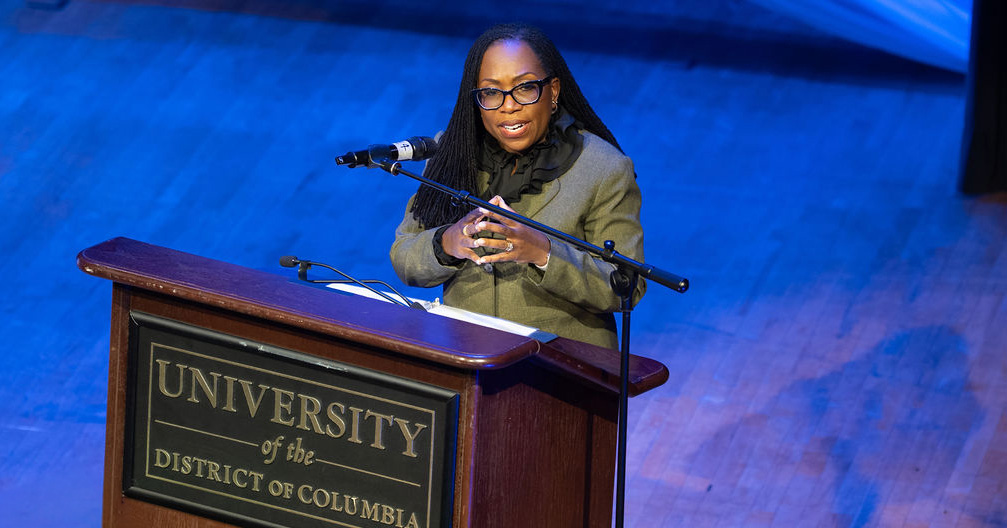
U.S. Supreme Court Justice Ketanji Brown Jackson focused on fairness in the judicial process, public understanding of the courts and the rule of law during the 31st Annual Joseph L. Rauh Jr. Lecture on Sept. 24 hosted by the University of the District of Columbia’s David A. Clarke School of Law.
Before a capacity audience filled with students and other members of the Firebird community, Jackson spoke on the Supreme Court’s emergency docket and the role that process plays in equal justice. She later joined Maya Wiley, UDC Law’s 2026-27 Joseph L. Rauh Jr. Professor of Civil and Human Rights, for a conversation that ranged from transparency and the rule of law to effective advocacy, public service and Jackson’s own place in history as the first Black woman to serve on the Supreme Court.
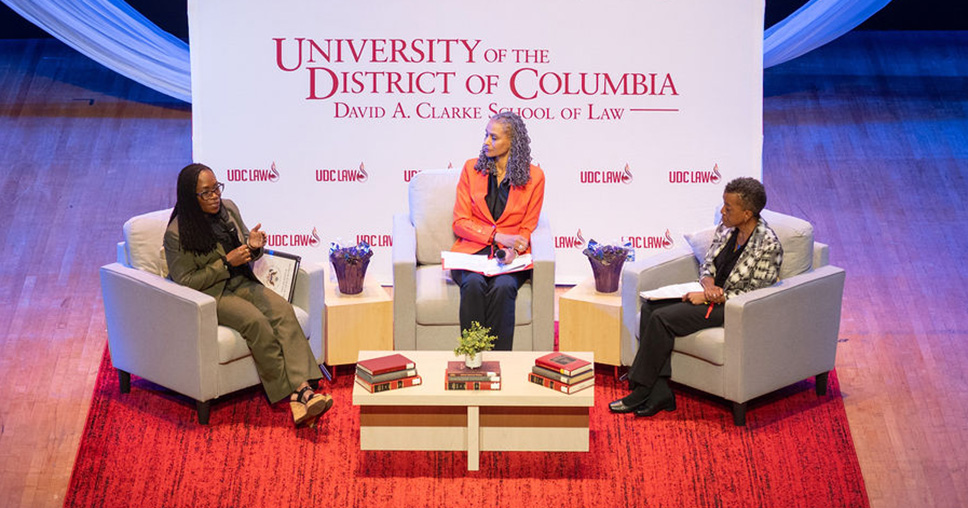
For UDC Law students, the evening carried particular meaning. Student Bar Association President Kloe Faucher opened by connecting the lecture to the school’s public-service mission.
“At UDC Law, we are taught that becoming a lawyer is about more than learning cases, preparing for exams or eventually passing the bar,” said Faucher. “We are taught that the law carries with it a responsibility to serve.” She told Jackson that her presence reminded students of the possibilities within the profession and challenged them to imagine what their own contributions might become.
Suzanne Rauh, granddaughter of Joseph L. Rauh Jr., reflected on the civil rights lawyer’s belief that every generation has a role in advancing justice. Her grandfather, she said, often observed that his generation had fought for equality in law and that it was up to the next generation to fight for equality in fact.
Wiley struck a similar note as she introduced Jackson, saying the country is in a moment when “we’re reminded every day that justice needs a champion.”
Jackson then turned to an aspect of justice that often receives less public attention than the outcome of a Supreme Court case: how the court gets there.
Rather than center her remarks on any one specific dispute, Jackson examined the emergency docket and how it operates. Emergency applications can ask the Supreme Court to step in while a case is still moving through the lower courts, including temporarily pausing a lower court order. Jackson said those requests traditionally played a more limited role in the judicial process and argued that the court’s more recent practices warrant greater attention because major issues are now being decided through that route.
Her central point was that equal justice depends not only on what courts ultimately decide, but also on whether people receive fair and consistent treatment through the process used to reach those decisions.
“The touchstone of equity is fairness,” Jackson said, adding that, in her view, the Supreme Court’s stay practices should be designed accordingly.
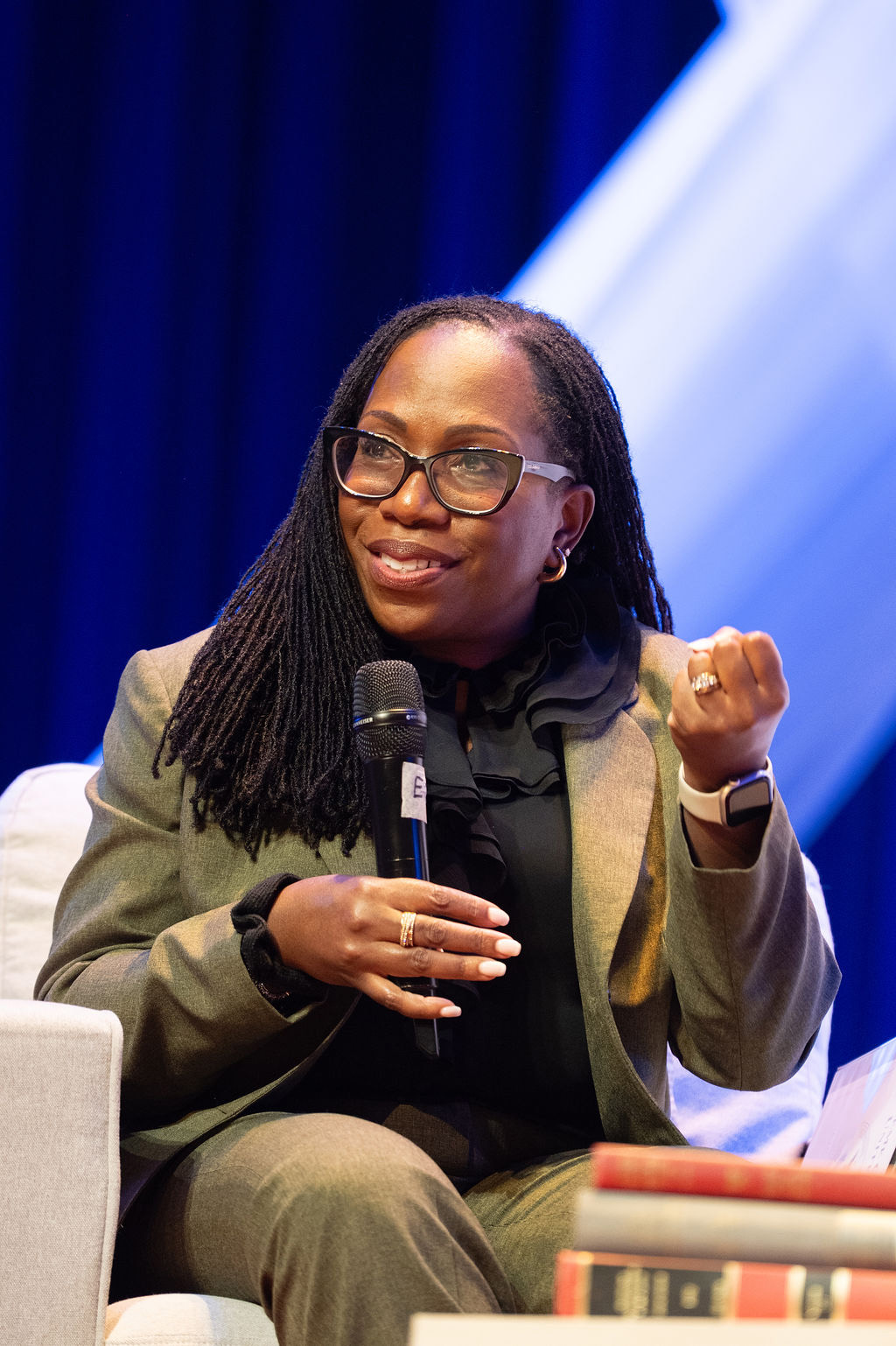 That principle carried into her conversation with Wiley. Jackson said process is something people do not always focus on when thinking about the law, even though “so much of equal justice” is accomplished through it. Lawyers and law students, she said, should examine not only a decision but whether the steps used to reach it resemble those used to make similar decisions in other cases.
Jackson also emphasized the importance of explaining the Supreme Court’s work to the public. Asked how she thinks about the audience for her opinions, she said she writes with the American people in mind, laying out facts and using language intended to help people understand what is happening in a case.
“We as judges are public servants,” said Jackson. “What I’m trying to do is make sure that the people understand what’s going on.”
She welcomed the growing use of explanations by her colleagues on the bench in some emergency docket orders, noting that written reasoning can help both the public and lower courts understand the principles being applied.
The discussion broadened from court procedure to the rule of law itself. Jackson described it as a foundational principle of the nation’s system of government: a country governed by laws rather than by the will of a king, dictator or autocrat. During periods of intense debate over government authority and executive power, she said, fundamental questions about the structure and functioning of government move back to the foreground.
Wiley also asked Jackson to reflect on representation and the history of UDC Law, whose predecessor, the Antioch School of Law, was co-founded by Jean Camper Cahn.
Jackson said she remains acutely aware of her own place in history. Born in 1970, she described herself as part of the first post-civil rights generation and noted that her parents grew up under segregation in the South. She said she feels profound gratitude for the opportunity to serve on the Supreme Court because many Black women who came before her had the ability to do the job but not the opportunity.
For the students in the room, that history carried a forward-looking message.
“Know that it is possible,” Jackson told them. “If I can do this, you can do this.” She said she tries to visit places where she can inspire people to pursue their ambitions, whether within the law or beyond it.
She concluded by encouraging UDC students not to become discouraged by inequities in the legal system, but rather to consider the progress previous generations had already made possible.
“In the long arc of history, we’ve come a long way,” she said. “And it’s up to us now to continue moving forward.”
Established in 1993, the Rauh Lecture honors civil liberties attorney Joseph L. Rauh Jr. and brings leading members of the bench and bar into direct conversation with UDC Law students and the District community. Jackson’s appearance continued that tradition while returning repeatedly to a theme especially relevant to future lawyers: justice depends not only on the law itself, but on the fairness, clarity and responsibility with which it is practiced.