


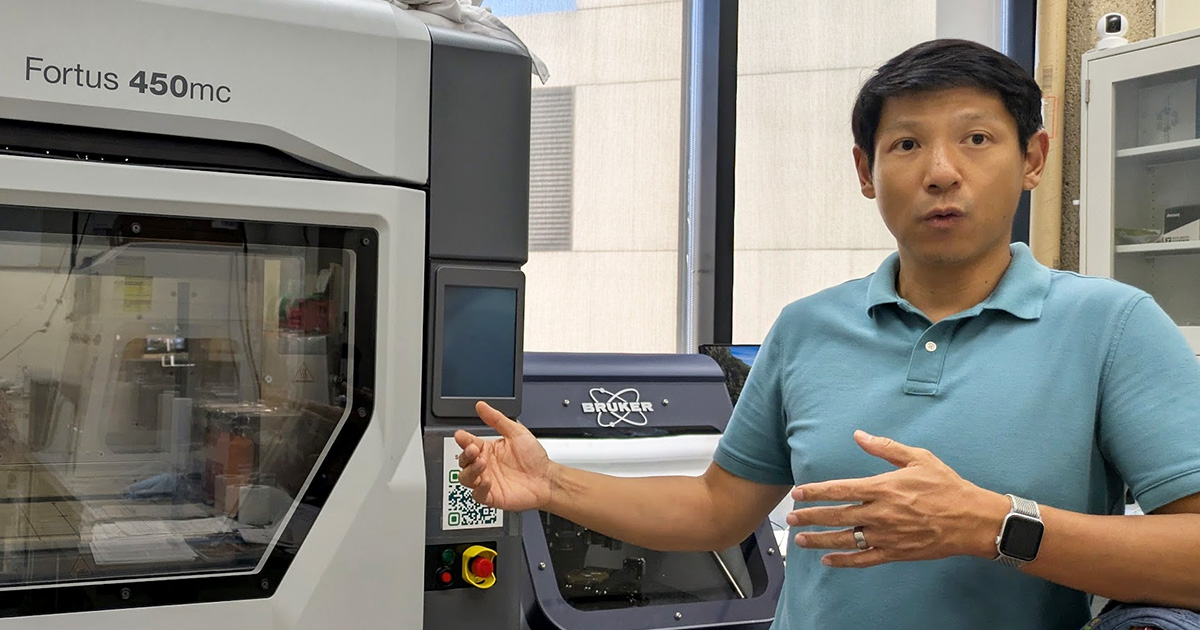
At the School of Engineering and Applied Science, what looks like an ordinary classroom door opens to a lab that is anything but. Inside, students fabricate components measuring one atom wide, design cooling systems for rockets and build prototypes that earned UDC some of its first patents. This is the Center for Advanced Manufacturing in Space Technology and Applied Research — better known as CAM-STAR — and it is where Professor JiaJun Xu, Ph.D., is proving that the sky is no limit for UDC students.
Since launching in 2020, CAM-STAR has grown into one of the most advanced labs in the region, equipped with specialized instrumentation ranging from thermal conductivity stations to lunar regolith simulators. More importantly, it is a place where students learn the skills and earn the credentials that propel them into careers with NASA, the U.S. Air Force and top research facilities across the country.
A Lab That Transforms Students’ Futures
For Xu, who has been with UDC for 12 years, the CAM-STAR mission is both personal and professional. His pairing of technical training with personal mentorship is one of the many things that sets his lab apart.
Xu believes that human connection is as important as any technical milestone.
“What I do here isn’t just a job; it’s an opportunity to change lives,” Xu said. “When I first visited UDC, I saw the potential. And I saw that I could shape the future for my students.”
That future includes many students from backgrounds historically underrepresented in STEM, who gain the rare chance at UDC to work alongside faculty on groundbreaking projects.
“I know my students,” he said. “I learn about their backgrounds, their educational interests and their career goals. We keep in touch long after they graduate.”
Xu is grateful that he can help students focus on their studies by lightening the financial load. “I work with a lot of nontraditional students, older students, students with young children, students juggling jobs with coursework and so on,” he said. “Thanks to grant funding, I can help support them so they can concentrate on achieving their goals.”
One of those students is Patrick Adegbaye, who earned a degree in applied mathematics from Bowie State before enrolling at UDC. He interned at Johnson Space Center and is now on track to complete his Ph.D. in mechanical engineering in spring 2026 – the first in his family to reach that milestone.
“UDC has been great,” said Adegbaye. “People here are welcoming. It’s a close-knit community. You don’t get lost. For someone like me, who wants to be an astronaut, this is a great place to start.”
Innovation with National Impact
CAM-STAR researchers are developing advanced heating and cooling systems for astronauts and redesigning air ducts for helicopters to improve performance for both pilots and engines.
The center has also become a national player in additive manufacturing and thermal management. A modular 3D-printed heat exchanger designed at UDC earned the university one of its first patents in 2022, with additional patents pending on aluminum cooling components and additively manufactured wick structures for space heat pipes. Two years ago, engineers from NASA’s Wallops Flight Facility visited to see UDC’s 3D printing capabilities. Based on the lab’s guidance, Wallops purchased its own equipment and later hired UDC alumni to help run it.
In the past five years, CAM-STAR has placed 50 students in NASA internships, with others moving directly into jobs with the Air Force, the National Transportation Safety Board and various NASA facilities. Still others have gone on to doctoral programs at universities like Michigan State and Howard.
A Promise for the Future
CAM-STAR embodies the university’s mission as both an HBCU and a public research institution for the nation’s capital: building sustainable research infrastructure, launching students into STEM careers and contributing innovations with national relevance.
For prospective students, Xu offers a simple invitation: come and see.
“This is institutional transformation,” he said. “When I first came to UDC, we didn’t have labs like this. Since CAM-STAR opened, I’ve been able to provide students with skills that are unique and in high demand. Here you get top-tier research experience with affordable tuition, one-on-one interaction with faculty and small class sizes. You are only gaining when you come to UDC.”