


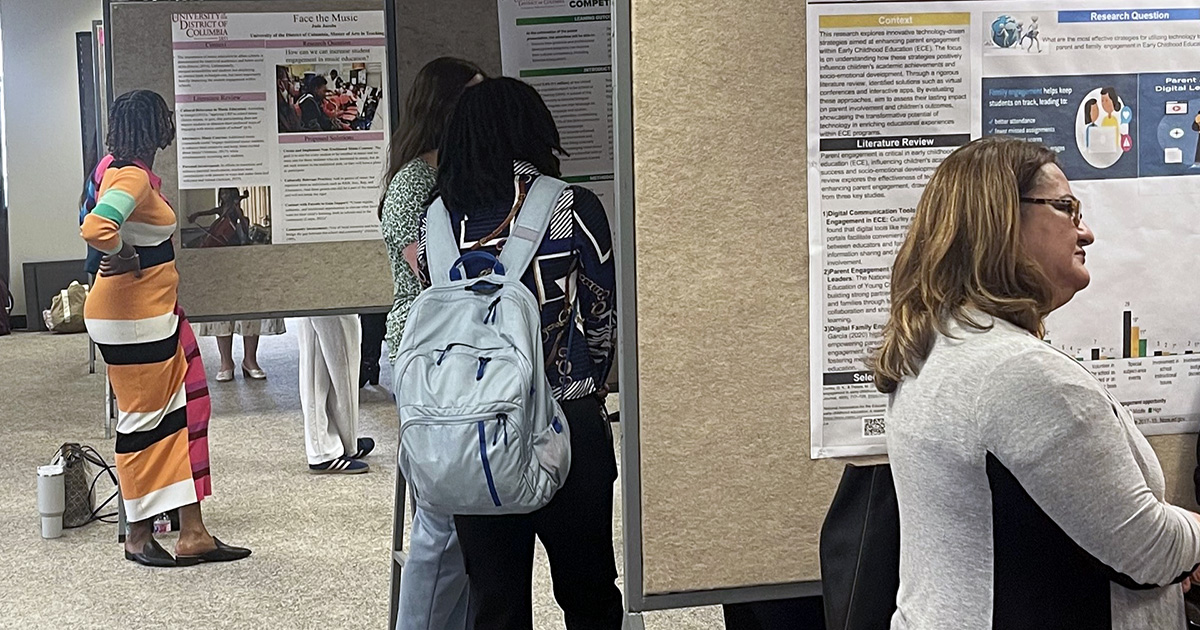
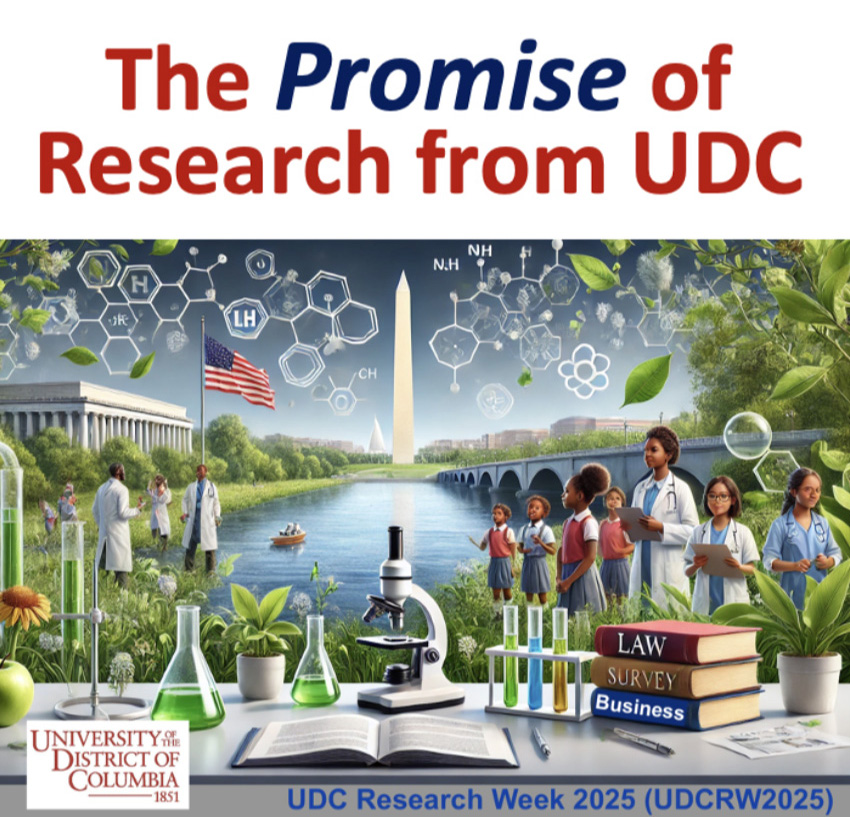
The College of Arts and Sciences (CAS) will take center stage on Thursday, April 3, as part of UDC’s Research Week 2025 (March 31-April 4), hosting a full day of presentations, posters and workshops that highlight its bold, community-minded scholarship. Guided by this year’s theme, The Promise of Research from UDC, CAS faculty and students will present work that not only advances disciplinary knowledge but also speaks to the needs of the District and the lived realities of its residents.
 “The CAS community is made up of bright and passionate change agents,” says Dean Jeffery Fleming. “Research conducted by our students and faculty focuses on pressing local and global issues, and the presentations submitted for Research Week 2025 once again seek to offer innovative solutions that can enhance the lives of District residents and the broader community.”
From science labs to art studios, classrooms to community spaces, CAS scholars are pursuing research that matters—research that reflects the needs and aspirations of UDC students and the city they call home.
Scholarship That Centers Community
“Research Week is an opportunity to learn about the diverse scholarly happenings taking place in the College of Arts and Sciences and to take a deep dive into what we are doing across our many degree programs,” says Associate Dean Anika Burtin. “What’s even more exciting is the opportunity Research Week provides to host our community partners, to demonstrate the outcomes of our partnership, and to explore new avenues of engagement. It’s about celebrating the work we accomplished and identifying new ways to collaborate.”
Throughout the day, attendees will see research presentations that embody CAS’s mission to produce graduates who are both highly educated and prepared to live and work in an increasingly multiethnic and technological society. This mission is especially evident in presentations that explore the complexities of urban life—studies that interrogate the intersections of race, identity, access and opportunity in a city that continues to evolve.
Across presentations, students are challenging assumptions and asking important questions: What does inclusion really look like in a diverse classroom? How do systemic inequities manifest in health care, public safety and housing? What does it take to build trust between institutions and the communities they serve?
Preparing Students to Lead
The CAS student projects are the product of immersive, experiential learning that provides them the opportunity to wrestle with current issues and explore creative solutions in real-world contexts. Topics range from public health disparities in the Black community to the cultural applicability of psychological theory; from archival storytelling as a tool for civic engagement to the potential of inclusive education.
Projects focused on educational equity, for instance, investigate how culturally relevant approaches to teaching can better serve Black math students and multilingual learners. Others confront the challenges of teacher retention in urban schools or explore the experiences of students with disabilities navigating postsecondary systems.
“The research you’ll see from CAS is a natural byproduct of the experiential learning experiences that we regularly cultivate for our students,” Burtin says. “It’s an opportunity for them to wrestle with problems of interest and practice and to develop expertise under the guidance of knowledgeable faculty.”
The college’s approach to scholarship dovetails with the university’s strategic plan and its emphasis on student achievement, applied learning and community impact as cornerstones of institutional excellence. The promise of research from CAS lies in not only what is discovered—but also in who is doing the discovering. Students are leading the way as scholars, storytellers and changemakers.
Research Rooted in Real Life
Whether the subject is bioinorganic chemistry or urban education policy, the arts or environmental health, the research on display is driven by a shared belief in the transformative power of knowledge. It is this diversity—of discipline, perspective and purpose—that gives CAS its unique strength.
“Among our goals during Research Week is to broaden the community’s understanding of what research is, who it’s for and how it can be used to make meaningful change—and to show that it’s not limited to labs or academic journals,” Fleming says. “CAS students and faculty represent a broad spectrum of research interests, including the natural sciences, applied sciences, humanities and arts. Given the diversity and profoundness of our scholarship, CAS truly does offer something for everyone.”