Skip To Translation Selection Skip To Top Navigation Skip To Content Skip To Footer
Campus Alert
Campus Updates


Microsoft Exchange Online Service Disruption

Microsoft is investigating a service disruption affecting Exchange Online users across the Americas. The University of the District of Columbia (UDC) is impacted, and some users may currently be unable to access their email.

Full details


UDC Facilities Update

At this time, a definitive timeline for reopening Buildings 32 and 42 has not been established. The reopening of these facilities remains contingent upon the successful completion of repairs, testing, inspections and confirmation that the affected electrical distribution equipment can be safely re-energized.

For safety concerns, contact OPSEM at 202-274-5050. For emergencies, call 911.

Full details

UDC News
Back to News

Chemistry Students Present Research at the 2022 ASCB Conference

January 11, 2023
Share:
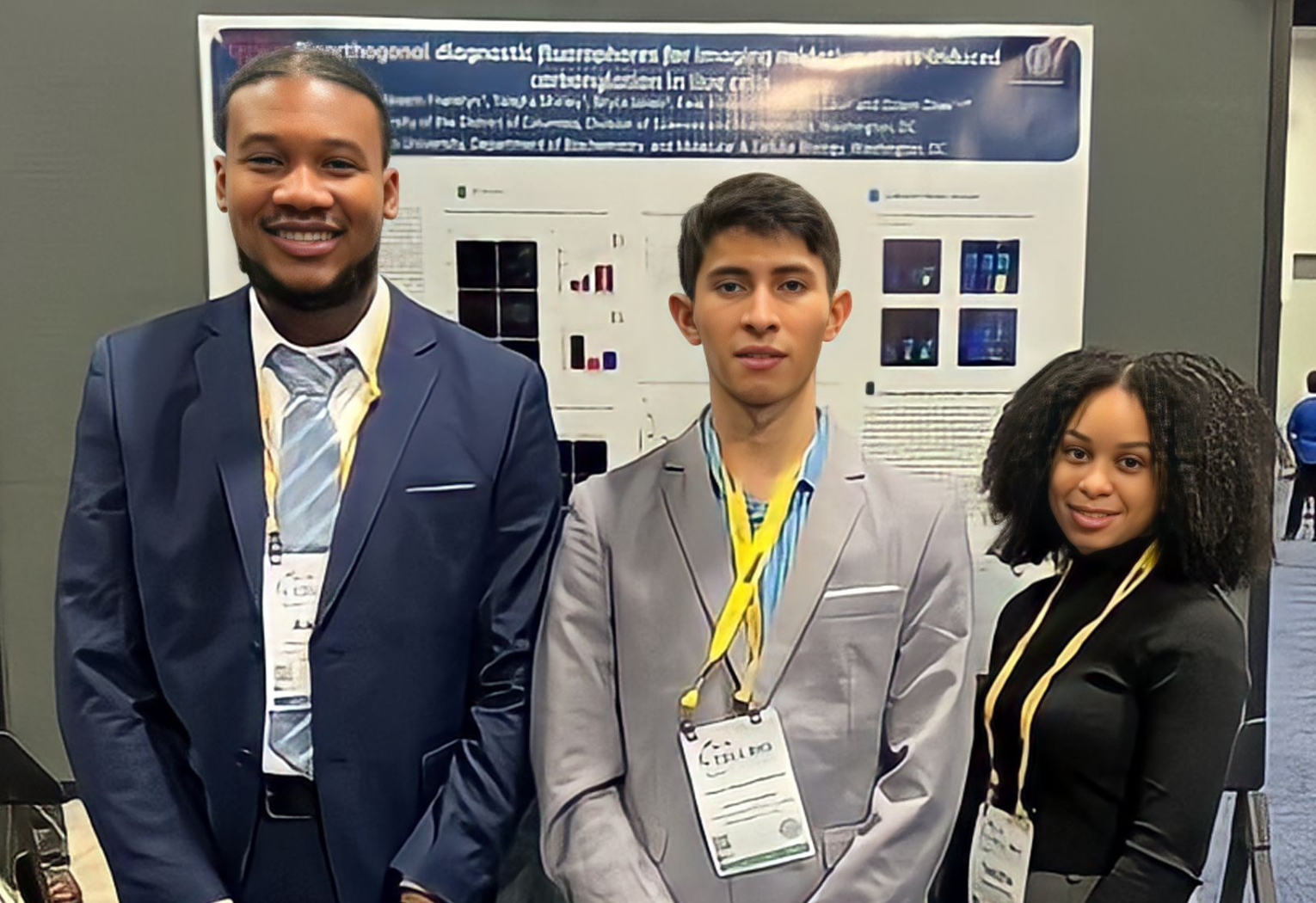
Akeem Franklyn, Julio Argueta and Talejha Shirley
Students Akeem Franklyn, Julio Argueta and Talejha Shirley at the ASCB Conference.

UDC undergraduate chemistry research students attended the National American Society for Cell Biology (ASCB) Conference 2022 in Washington, DC from December 3-7, 2022 with Assistant Chemistry Professor Dr. Ozlem Dilek, who is fully funded and supported by ASCB ACT and FRED programs. Dilek teaches organic chemistry I and II and its labs at the University. Senior biology majors Akeem Franklyn and Talejha Shirley and junior chemistry major Julio Argueta presented their research on December 5, under the Chemical Cell Biology session titled “Bioorthogonal diagnostic fluorophores for imaging oxidative stress-induced carbonylation in live cells.” The research was done in partnership with Georgetown University Medical Center.

According to their mission statement, ASCB is an inclusive, international community of biologists studying the cell, the fundamental unit of life, and dedicated to advancing scientific discovery, advocating sound research policies, improving education, promoting professional development, and increasing diversity in the scientific workforce.

Back to Top
Take The Next Steps, Today!