


 With the help of a grant funded by the National Science Foundation (NSF), Dr. Anshu Arora and her students have set out to find ways to make learning more accessible and engaging for autistic students through the use of robots.
The School of Business & Public Administration (SBPA) was awarded a $299,982 Research Initiation grant from NSF for support robots that aid learning-disabled students through the Social Motivation Approach for Rehabilitation Through Educational Robotics (SMARTER) research.
It is one of the first business schools in the country to receive multiple NSF grants, including research initiation award, targeted infusion project, and catalyst award in STEM-Business related multidisciplinary fields. While the School of Business does not typically receive NSF grants, Dr. Arora brings a unique advantage to the opportunity. She is an associate professor of marketing and focuses on STEM business projects. She holds a Ph.D. in marketing and technology and is an electrical and electronics engineer. She is a PI on two and a Co-PI on one of the NSF projects at SBPA.
The SMARTER research is designed to obtain new scientific knowledge on social, cognitive, and behavioral relationships in educational robotics for developmental disorders such as Autism spectrum disorder (ASD) in the middle and high schools in the District of Columbia Public Schools (DCPS) and the University of the District of Columbia (UDC).
“This is a multidisciplinary pursuit for me,” said Arora, principal investigator for the grant. “That’s the exciting part. We’ve rarely worked on something engineering-related. When I wrote the grant, I never thought we would get funded. NSF said to us that the beauty of the proposal was that it was multidisciplinary, and the School of Business initiated it. We plan to get other colleges and departments involved in the future, including engineering, sciences and education.”
The research will fill a gap by providing insights into educational-social robotic interventions. The team will work with autistic students at Hardy Middle School, McKinley Tech High School and UDC undergraduate students who experience learning/cognitive disabilities.
Industry collaborators for the project are Movia Robotics (a Connecticut-based company that specializes in autism-related software for social robots); RobotLAB (a San Francisco-based company that provides robots for K-12 and higher education); Anthrotronix Inc. (a company that specializes in cognitive assessment, therapeutic and education interventions, and human-computer interface technology); and The Lab @ DC (a research team in the DC Mayor’s administration).
The SMARTER research project strengthens UDC’s research capacity for students and faculty in the interdisciplinary education, social-cognition, and robotics fields and provides research training and opportunities.
“Social robotics is emerging, and the continued investment in research is dear to my heart as a social scientist and business professor,” Arora said. “While the robots are often used with the elderly population, they can be instrumental in supporting children, especially those with learning disabilities and autism. The work being done at UDC will have a deeper social impact.”
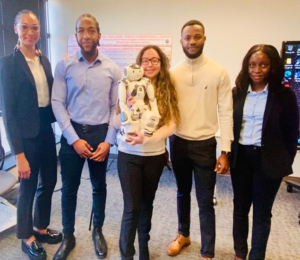
Dr. Arora’s team includes seven undergraduate UDC students, who receive research stipends. Students engage in software creation and training in Artificial Intelligence and machine learning. Her team includes Andrew Sammonds (BBA Finance), Grace Yepez (BBA Marketing), Emily Osbourne (BBA Accounting), Chevell Parnell (BS Biology), Demario Asquitt (Computer Engineering), Allan Muir (Computer Engineering), and Antwan Brady (BBA Finance).
The partnership with DCPS allows two three-and-a-half-foot NAO social robots to engage autistic students at each school to determine whether they relate better to a robot for instruction.
The student is first introduced to the robot by guided instruction and is prompted to respond using an iPad. Another team member uses a computer to control the robot to give real-time answers and questions out of view of the student. Instruction lasts for 30 minutes, followed by an additional 30 minutes of observation.
Though the robot has facial recognition and is capable of walking, it sits on the desk facing the student to increase focus and avoid overstimulation. The student’s Individual Education Plan (IEP) is being used to design tailored instruction in consultation with school counselors.
Dr. Arora applied for the grant after learning that robotic learning was not being used in DCPS. Her team will support 15 students over the life of the three-year grant.
The three main objectives of the SMARTER research are to examine social-behavioral relationships and social cognition in autistic students through social-educational robotics; investigate robotic anthropomorphism and intentionality targeted at autistic students; and develop curriculum-related interactive scenarios designed for improving cognitive rehabilitation through robotic interventions in DCPS and UDC undergraduates.
The research will include surveys, focus groups, interviews, structured content analysis, and structural equation modeling.
UDC’s research team will also provide design recommendations to robotic companies to assist ethical curriculum needs in universities and schools in Washington. So far, Arora and her student team has developed curriculum robotic intervention scenarios in association with Movia Robotics for areas like conflict resolution, job interviews, and college application process through NAO robots targeting high school students.
At the completion of the grant in 2024, Arora hopes to renew with funding up to $1 million and include other departments such as computer science and education.
“Every time we go out, we are mapping out personality types and examining social behavior and cognition through social robotics,” Arora said. “Autistic students need instruction to be given the same way each time, with no judgment. Robots will be consistent. This is an exciting time, and we are happy to be a part of this.”